
In today's gem market, a stone that sparkles beautifully could be the product of nature over millions of years, a crystal grown in a laboratory in just a few weeks, a natural stone treated to improve its color, or simply a skillfully cut piece of glass. These four cases differ in value by tens — sometimes hundreds — of times, yet they are very hard to tell apart with the naked eye. This is precisely why a gem buyer needs to understand the nature of each group before paying.
From a gemological standpoint, GemLab draws a clear line between four concepts that are often confused: natural gemstones, synthetic (lab-grown) gemstones, treated gemstones, and imitation (simulant) stones. Understanding these four groups correctly not only helps you avoid overpaying, but is also the foundation for reading a laboratory report and properly valuing the stone you own.
Contents:
- Four concepts you must distinguish
- Synthetic is not the same as fake
- Common treatments & disclosure
- Telling them apart by observation & testing
- Composite stones & common tricks
- When to send a stone to a laboratory
Four concepts you must distinguish
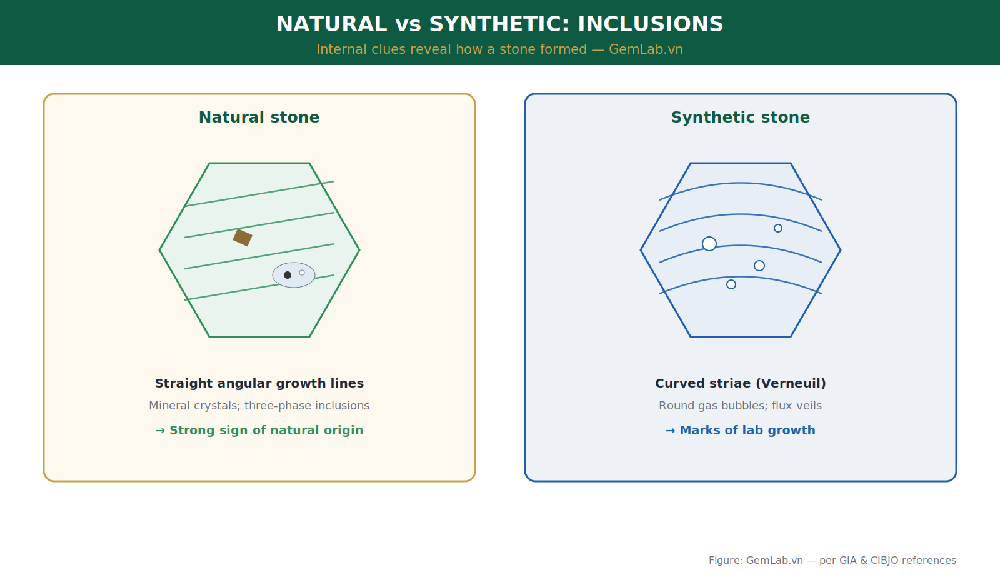
Natural gemstones. A natural gemstone is a mineral formed within the earth through natural geological processes, with no human involvement in creating the crystal. Humans only mine, cut, and polish it. The slow crystallization under complex geological conditions leaves each natural stone its own "fingerprint": mineral inclusions, growth lines, and uneven color zoning. Under the standard of CIBJO (the World Jewellery Confederation), the word "gem" used alone defaults to a natural stone; every other case must carry an explicit qualifying adjective.
Synthetic (lab-grown) gemstones. A synthetic gemstone is a crystal grown by humans in a laboratory, but with the same chemical composition, crystal structure, and physical-optical properties as the corresponding natural stone. In other words, a synthetic ruby is still genuine corundum, and a synthetic diamond is still genuine crystallized carbon. The only difference is origin: one is made by nature, the other by people. Common growth methods include flame-fusion (Verneuil), crystal pulling (Czochralski), flux growth, and hydrothermal growth. Because it is tightly controlled in the laboratory, synthetic material is often very clean, evenly colored, and far cheaper than a natural stone of the same appearance.
Treated gemstones. A treated gemstone is still a natural stone, but one that humans have altered by artificial means to improve its color, clarity, or durability. The most common is heat treatment — most ruby and sapphire on the market today have been heated. Other treatments include fracture filling, oiling (for emerald), diffusion, irradiation, and dyeing/bleaching. Treatment does not turn a stone into a "fake," but it changes the value and sometimes the care requirements, so it must be disclosed. Heat treatment specifically is covered in detail in the heat-treated gemstones article.
Imitation (simulant) stones. An imitation, or simulant, is a material that merely mimics the appearance of a gemstone without having the same composition and crystal structure. Classic examples are cubic zirconia (CZ) and moissanite imitating diamond, lead glass (paste) imitating emerald, or "Slocum" glass imitating opal. In some cases a cheap gemstone is used to imitate an expensive one — for instance red garnet posing as ruby, or tanzanite posing as sapphire. Simulants have very low value and poor durability, and are entirely different in nature from natural or synthetic stones.
| Criterion | Natural | Synthetic | Treated | Imitation / simulant |
|---|---|---|---|---|
| Origin | Nature | Laboratory | Nature + intervention | Man-made, imitative |
| Chemical composition | Mineral-specific | Identical to natural | Same as natural | Entirely different |
| Crystal structure | Yes | Yes, like natural | Yes | Often amorphous (glass) |
| Example | Myanmar ruby | Verneuil ruby | Heat-treated sapphire | CZ, glass, garnet-as-ruby |
| Relative value | Highest | Low | Moderate, depends on treatment | Very low |
Synthetic is not the same as fake
This is the most misunderstood point. Many people lump everything "not natural" together as "fake," but from a gemological standpoint that label is wrong. A synthetic stone is a real stone mineralogically: it has the same hardness, the same refractive index, and the same absorption spectrum as the natural stone. A synthetic sapphire still reaches 9 on the Mohs hardness scale, just like natural sapphire. What differs is only its origin and — flowing from that — its rarity and collectible value.
A simulant such as glass or CZ, by contrast, is an entirely different material: low in hardness, easily scratched and chipped. So when reading a report or invoice, you need to distinguish three phrases clearly: "synthetic / lab-grown," "imitation / simulant," and "treated." These three concepts reflect three levels of value and three completely different stories.
Common treatments & disclosure
Treating gemstones is an age-old practice and largely accepted by the market, as long as it is honestly disclosed. According to the CIBJO Blue Book, each treatment group has its own disclosure requirement, and some methods change value more strongly than others. The table below summarizes the most commonly encountered treatments.
| Method | Purpose | Common stones | Durability & notes |
|---|---|---|---|
| Heat treatment | Improve color, dissolve silk inclusions | Ruby, sapphire | Stable, widely accepted |
| Fracture filling | Hide fractures, raise apparent clarity | Ruby (lead glass), emerald | Less durable, needs careful handling |
| Oiling | Reduce visibility of fractures | Emerald | Can dry out over time |
| Diffusion | Create/enhance surface-layer color | Sapphire (Be, Ti) | Color only at the surface; risky to recut |
| Irradiation | Create or deepen color | Topaz, some diamonds | Color stability should be checked |
| Dyeing / bleaching | Add or even out color | Jade, pearl, coral | Less durable, can fade |
CIBJO's golden rule of disclosure is that the word "treated" must be stated clearly and placed on equal footing with the stone's name in every description. For treatments that change value significantly — such as lead-glass filling in ruby or beryllium diffusion in sapphire — the seller is responsible for specifying exactly what was done so the buyer understands precisely what they are paying for.
Telling them apart by observation & testing
Separating natural from synthetic from fake is the work of gemology, based on systematic observation from simple to advanced. Each growth method leaves characteristic clues inside the stone, and these are the single most important evidence.
Inclusions. Inclusions are the "historical documents" recording how a stone formed. Natural stones often contain mineral inclusions such as rutile silk, foreign crystals, two-phase liquid-gas fingerprints, or — especially — three-phase inclusions (solid-liquid-gas). Three-phase inclusions have so far not been commonly reproduced in the laboratory, so their presence is a strong indicator of natural origin.
Conversely, synthetic stones carry traces of the growth process: round or tadpole-shaped gas bubbles (in flame-fusion material and glass), milky-white flux remnants resembling breadcrumbs or cobweb veils (in flux-grown material), or unusual wavy growth banding (in hydrothermal material). Flame-fusion material crystallizes at ordinary pressure and so readily retains gas bubbles — something that does not happen with magmatic stones formed at high pressure in nature.
Growth lines & color zoning. This is one of the decisive signs. The Verneuil process always produces curved striae — curved growth lines visible under suitable magnification and lighting. As gemologists affirm: no natural mineral produces such curved lines; natural corundum has only straight, angular growth lines. The presence of curved striae is therefore almost certain evidence of synthetic origin. Similarly, color zoning in natural stones is usually angular, following the crystal structure, because geological conditions distribute trace elements unevenly. In synthetic stones, color is usually distributed in curved bands or perfectly evenly, reflecting the tightly controlled growth environment.
Refractive index & optical properties. When observing inclusions is not enough to conclude, a gemologist turns to instruments. The most important is the refractometer, used to measure the refractive index (RI) and birefringence — which identify the mineral species. This is the quick way to rule out fakes: glass is a singly refractive (isotropic) material with an RI of about 1.5, completely different from corundum (about 1.76) or many other colored stones. If the measured value does not match the species the seller claims, that is a clear warning sign. Note: because a synthetic stone has the same RI as the natural stone of the same species, the refractometer alone cannot separate natural from synthetic — that step must rely on inclusions and growth lines under the microscope. The refractometer is mainly for ruling out fakes and confirming the species. This is also why a serious laboratory always combines several methods rather than relying on a single instrument.
| Sign | Natural | Synthetic | Imitation / simulant |
|---|---|---|---|
| Growth lines | Straight, angular | Curved (striae) | No crystal structure |
| Round gas bubbles | Almost never | Yes (flame-fusion) | Often present (glass) |
| Three-phase inclusions | Possible (strong sign) | Almost never | None |
| Refractive index | Correct for species | Correct for species | Off (glass ~1.5) |
| Hardness | Species-specific | Like natural | Usually lower |
Composite stones & common tricks
A sophisticated form of fake is the composite stone (doublet, triplet): a thin layer of genuine gem material is bonded onto a cheap base such as glass or another stone, creating the impression that the whole stone is gem-quality. The telltale signs are a separation plane seen when viewed at an angle, an unusual flash effect at the junction, and sometimes gas bubbles trapped in the glue layer. Observing the stone immersed in water or viewed from the side often reveals this composite structure.
Buyers should also beware the "deal too good to be true": a large, clean, fine-colored ruby or emerald at an unusually low price is almost certainly synthetic, heavily treated, or fake. The safe principle is always to request a laboratory report from an independent lab before buying valuable stones. For a foundational view of how to assess colored-stone quality, the cluster of GemLab's Vietnamese gemstone pages — ruby, spinel, and sapphire — provides species-level reference.
When to send a stone to a laboratory
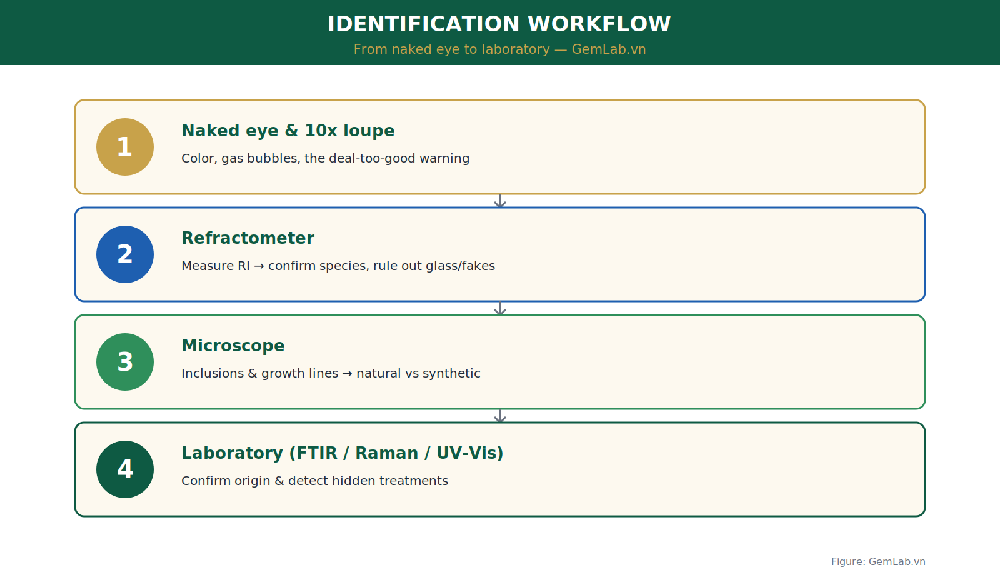
Observation with a 10x loupe and a microscope can answer many questions, but for high-value stones or doubtful cases, the final conclusion should come from an independent laboratory. Advanced instruments such as infrared spectroscopy (FTIR), Raman spectroscopy, UV-Vis absorption spectroscopy, and fluorescence analysis make it possible to determine natural versus synthetic origin with certainty, and to detect treatments the naked eye cannot see.
From a gemological standpoint, GemLab recommends: request a laboratory report for any stone of significant value before a transaction, and prefer independent labs that do not also trade in stones, to avoid conflicts of interest. You can learn about the process on GemLab's gemstone testing service page.
Reference standards: CIBJO Blue Book (terminology and disclosure for natural, synthetic, treated, and imitation stones); GIA gemological references on growth structures and inclusions in synthetic corundum (curved striae in flame-fusion material); standard gemological practice on refractometry and microscopy. Market information is time-sensitive.
Frequently asked questions
Is a synthetic stone a fake? No. A synthetic stone has the same chemical composition, crystal structure, and physical properties as a natural stone, so mineralogically it is a real stone. It differs only in origin: it is grown in a laboratory rather than formed in the earth. An imitation (simulant) is the one that is different in nature, merely copying the appearance.
How can I tell whether a stone has been treated? Some treatments leave observable signs, such as fracture filling with an unusual luster, or abnormal color concentration in a dyed stone. However, many treatments such as heating are very hard to detect by eye and require laboratory instruments. The surest way is to request a laboratory report, since under international standards every treatment must be disclosed.
What do curved lines in a stone mean? Curved striae are curved growth lines produced by the flame-fusion process. Because no natural mineral has curved lines, their presence is almost certain proof that the stone is synthetic. This is one of the most important signs when examining corundum under the microscope.
Can a refractometer alone separate natural from synthetic? Not entirely. Because a synthetic stone of the same species has an identical refractive index to the natural stone, the refractometer only helps confirm the species and rule out fakes such as glass. To separate natural from synthetic, you need to examine inclusions and growth lines under the microscope, or use advanced laboratory methods.
Should I buy a treated gemstone? You can, if the treatment is transparently disclosed and the price reflects it. Many treatments such as heating corundum are widely accepted by the market and stable over the long term. The issue is not whether a stone is treated, but whether the information is honest. Always request clear disclosure and a laboratory report for high-value transactions.
Have a stone you are unsure about? An independent laboratory specializing in colored stones separates natural from synthetic from fake, assesses treatment, and is transparent about limitations. See GemLab's gemstone testing service.
Related GemLab references
Apply this method to specific Vietnamese stones in GemLab's gemstone cluster: Vietnamese gemstones overview, Luc Yen ruby, Luc Yen spinel, and Vietnam sapphire. To have a stone examined, see GemLab's gemstone testing service. For a worked example of one common imitation, see moissanite vs diamond.
Related reading
For a worked example of how a laboratory separates natural, HPHT and CVD diamonds by type and growth structure, see our guide to diamond testing: the 4C standard, diamond type and lab-grown detection.