
Moissanite is a gemstone born from a meteorite — and one that once fooled a Nobel Prize-winning chemist. Today it is the world's most popular diamond alternative, and at the same time the "rival" every laboratory must rule out when testing a sparkling white stone. In essence, moissanite is silicon carbide (SiC), a mineral with the highest fire among common gemstones. This article presents the full scientific picture of moissanite: its optical and physical properties, why thermal testers fail on it, how to separate it from diamond, and its standing as a legitimate gemstone in its own right.
From a gemological standpoint, GemLab follows the original GIA (Gems & Gemology) description of synthetic moissanite and the mineralogical literature. This page belongs to the testing cluster; it is closely tied to the question of how to tell natural, synthetic, and imitation stones apart.
Contents:
- What moissanite is & the meteorite story
- Optical & physical properties
- Moissanite vs diamond: how to tell them apart
- Why thermal testers fail
- Moissanite vs CZ vs lab-grown diamond
- Moissanite as a gemstone & testing
What moissanite is & the meteorite story
Moissanite is the gemological name for the mineral silicon carbide (formula SiC). Its discovery story is one of the most remarkable in mineralogy: in 1893, the French chemist Henri Moissan found tiny crystals in rock taken from the Canyon Diablo meteorite crater (Arizona, USA). At first he mistook them for diamond; only in 1904 did he identify them as silicon carbide. The mineral was later named moissanite in his honor.
Natural moissanite is extremely rare — it exists only as microcrystals in meteorites and in a few rocks sourced from the deep mantle of the Earth. Because of this rarity, almost all moissanite in the jewelry market is synthetic moissanite: SiC crystals grown in the laboratory from pure silicon and carbon at very high temperature. According to GIA, synthetic moissanite shares exactly the same physical, chemical, and optical properties as the natural, meteorite-sourced version — in other words, it is a genuine mineral, differing only in how it formed. The near-colorless moissanite used in jewelry was commercialized in 1998.
One technical detail makes silicon carbide unique: this mineral can crystallize in more than 150 different atomic arrangements (called polytypes), each with its own physical and electronic properties. This structural diversity is precisely why SiC is both an important semiconductor material in industry and the number-one candidate for imitating diamond in jewelry. Natural SiC crystals are usually black and opaque because of many impurities; only when high-purity, near-colorless crystals can be grown does moissanite qualify as a gemstone.
The leap from industrial abrasive to gem material came from crystal-growth technology developed for the semiconductor industry. For most of the twentieth century, manufactured silicon carbide — long known under trade names such as carborundum — served as a hard grinding and cutting abrasive, far from anything resembling a gem. Producing single crystals large enough, clean enough, and near-colorless enough to facet was the real breakthrough, and it is why gem moissanite reached the market only at the very end of the 1990s rather than decades earlier. Understanding this history matters for a buyer: moissanite is not a "new discovery" of a natural gem but the gem-quality output of a mature, controlled manufacturing process, which is also why its supply is effectively unlimited and its pricing behaves quite differently from a mined stone.
Optical & physical properties
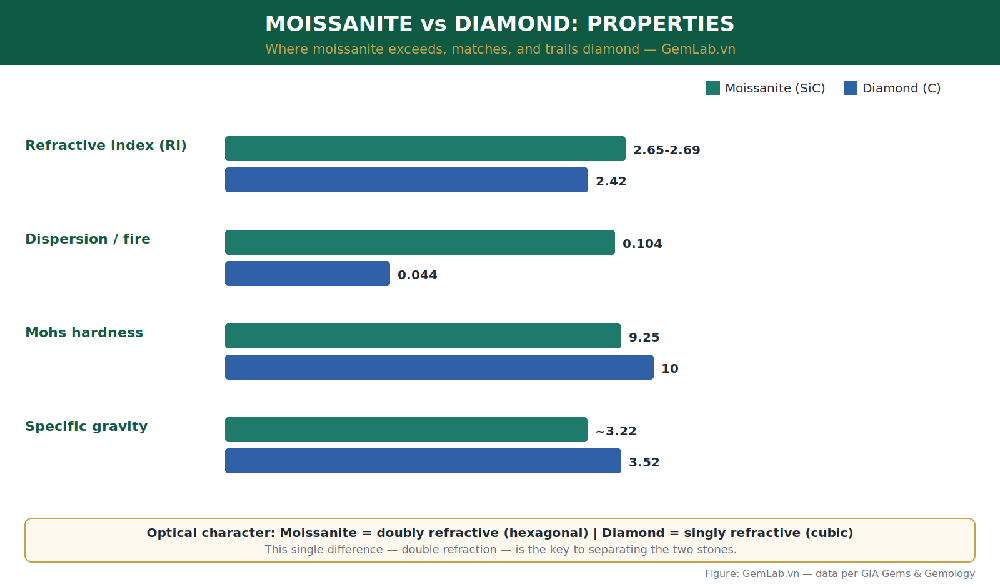
What makes moissanite the most successful diamond imitation in history is that it exceeds diamond on a few optical measures while coming close on others:
| Property | Moissanite (SiC) | Diamond (C) |
|---|---|---|
| Composition | Silicon carbide | Pure carbon |
| Refractive index (RI) | 2.648–2.691 (higher) | 2.42 |
| Dispersion (fire) | 0.104 (~2.4× higher) | 0.044 |
| Mohs hardness | 9.25 (second hardest) | 10 (hardest) |
| Specific gravity (SG) | ~3.22 (lighter) | 3.52 |
| Optical character | Doubly refractive (hexagonal) | Singly refractive (cubic) |
The first two numbers explain moissanite's dazzling look. A refractive index of 2.65–2.69 (versus 2.42 for diamond) makes it bend and reflect light more strongly, giving high brilliance. A dispersion of 0.104 — about 2.4 times that of diamond — produces vivid rainbow flashes of "fire." This is why, under strong light, a large moissanite shows rainbow colors more obviously than diamond; for many people this is a plus, but for those who prefer the pure white sparkle of diamond it is a giveaway.
The single most important property for testing, however, lies in the last row of the table: moissanite has a hexagonal crystal structure and is therefore doubly refractive (anisotropic) — each ray of light entering it is split in two. Diamond has a cubic structure and is singly refractive (isotropic). This is a fundamental, ineradicable difference, and it is the key to separating the two stones.
The reason moissanite has such brilliant fire also stems from that same hexagonal structure: it bends and splits light more aggressively than the cubic structure of diamond and CZ. In other words, the two features that create both moissanite's beauty and its identifying clue — superior fire and the doubling phenomenon — arise from the same crystallographic origin. This is a fine example of how, in gemology, appearance and identifying signature are two sides of the same physical nature.
Moissanite vs diamond: how to tell them apart
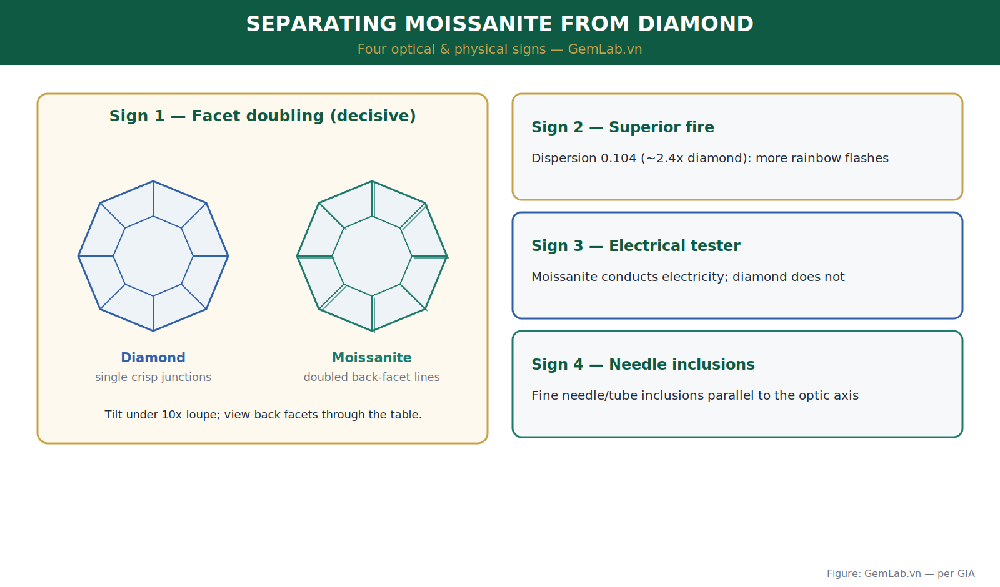
Because moissanite is closer to diamond in hardness, specific gravity, and hand feel than any earlier diamond imitation, separating it relies on optical features. Four core signs:
| Sign | How it appears |
|---|---|
| Facet doubling | From double refraction: tilting and looking through the table, the back facet junctions appear doubled — sometimes even visible to the naked eye |
| Superior rainbow fire | Dispersion ~2.4× diamond → noticeably more rainbow flashes |
| Moissanite (electrical) tester | Moissanite conducts electricity; an electrical-conductivity tester separates it from diamond |
| Parallel needle inclusions | Many moissanites contain fine needle/tube inclusions parallel to the optic axis |
Of these, facet doubling is the most decisive and reliable evidence. GIA states clearly that synthetic moissanite can be separated from diamond by its double refraction — the phenomenon that produces doubling at the facet junctions. A gemologist need only tilt the stone under a 10× loupe and observe the back facets carefully: if doubled lines appear, it is almost certainly not diamond.
In practice, the observation has a correct technique. The doubling is seen by looking down through the table at the junction lines of the back (pavilion) facets, not the front, because the light path through the depth of the stone maximizes the visible separation. The effect is strongest when viewing across the stone rather than straight down the optic axis, so a slow tilt is essential — a stone held at a single fixed angle can hide the doubling entirely. On larger stones the separation may be wide enough to catch with the unaided eye, while on small melee it can require steady magnification and good lighting. This is also why a single quick glance is never a substitute for systematic examination, and why one ambiguous stone is enough reason to seek a laboratory opinion.
Why thermal testers fail
This is one of the most important lessons in testing, and the reason moissanite caused a small "crisis" in the trade when it first appeared. Older diamond testers worked by measuring thermal conductivity — which is very high in diamond and low in most imitations such as glass or cubic zirconia. But moissanite also conducts heat very well, close to diamond, so thermal testers react to moissanite as if it were "diamond." According to GIA's description, moissanite's thermal properties are so close to diamond that the thermal probes on the market are all "fooled."
The trade's solution was a tester based on electrical conductivity: moissanite conducts electricity while diamond (except boron-bearing type IIb) does not, so a dual thermal-electrical tester separates the two. Even this device is not absolute, however, because silicon carbide exists in more than 150 atomic arrangements (polytypes) with differing electrical properties. That is why optical evidence — especially the doubling phenomenon — remains the most reliable basis for separation, and why a laboratory report is worth more than any handheld tester.
Moissanite vs CZ vs lab-grown diamond
Three stones are often lumped together as "artificial diamond," but they are very different in nature — and telling them apart is the core of white-stone testing:
| Criterion | Moissanite | Cubic Zirconia (CZ) | Lab-grown diamond |
|---|---|---|---|
| Nature | Silicon carbide (SiC) | Zirconium dioxide | Carbon — real diamond |
| Relation to diamond | Different stone, imitation | Different stone, imitation | Is diamond (different origin) |
| Mohs hardness | 9.25 | ~8.25 | 10 |
| Fire (dispersion) | 0.104 (very high) | 0.060 | 0.044 |
| Thermal tester | "Passes" as diamond | Rejected at once | "Passes" (is diamond) |
The core difference: moissanite and CZ are imitations (different materials that merely copy diamond's appearance), while HPHT/CVD lab-grown diamond is real diamond chemically, differing only in how it formed. Separating these three — together with natural diamond — is precisely why white-stone testing requires both optical observation and, at a higher level, spectral analysis. Detail on separating lab-grown diamond belongs in a dedicated diamond-testing reference.
Moissanite as a gemstone & testing
An important point to state plainly: moissanite is not a "fake" in the pejorative sense, but a legitimate gemstone when sold under its true name. With a Mohs hardness of 9.25 (second only to diamond), high durability, brilliant fire, and a price far below diamond, moissanite is favored as a diamond alternative in wedding rings and jewelry — especially by those who value cost and avoid mined stones. The only ethical line is transparency: selling moissanite as moissanite is legitimate; selling it as diamond is fraud.
The arrival of near-colorless moissanite in 1998 was a turning point for the testing industry: for the first time a material appeared that resembled diamond closely enough to "pass" common thermal testers, forcing the whole trade to upgrade its tools and procedures. In that sense, moissanite is not only a gemstone but a catalyst that pushed modern gemology to develop more refined methods of separation — its technical legacy is far greater than its role as a mere jewelry stone.
This is why testing protects the buyer. For a white stone, a laboratory determines whether it is diamond (natural or lab-grown), moissanite, CZ, or another stone — using only non-destructive tests. For moissanite specifically, facet doubling together with the electrical-tester response is usually enough for a quick, confident conclusion. GemLab performs this separation with gemological instruments, and states clearly when a case needs deeper analysis. See GemLab's gemstone testing service.
Reference standards: the original synthetic-moissanite description per GIA Gems & Gemology (Nassau et al., published by C3 Inc., 1997) — refractive index 2.648–2.691, dispersion 0.104, hardness 9¼ Mohs, specific gravity ~3.22, double refraction producing facet doubling, thermal probes reacting as for diamond; discovery history per Henri Moissan (1893, Canyon Diablo crater) and SiC mineralogy; more than 150 polytypes per the silicon-carbide technical literature. These figures are stable physical data.
Frequently asked questions
Is moissanite a diamond? No. Moissanite is silicon carbide (SiC), a mineral entirely different from diamond (pure carbon). It is the most popular diamond imitation, but it is a distinct gemstone with value of its own.
How do I tell moissanite from diamond? The surest sign is facet doubling, caused by moissanite's double refraction — tilting the stone under a loupe reveals the back facet junctions appearing doubled. Moissanite also has superior rainbow fire and responds to an electrical-conductivity tester.
Why does a diamond tester read moissanite as "diamond"? Because older testers measure thermal conductivity, and moissanite conducts heat almost like diamond. You need an electrical-conductivity tester (moissanite conducts electricity, diamond does not) or, best, optical testing to be sure.
Is moissanite durable enough for daily wear? Very durable. With a Mohs hardness of 9.25 (second only to diamond) and good toughness, moissanite resists wear very well, suiting wedding rings and everyday jewelry.
Does moissanite show more rainbow color than diamond? Yes. Moissanite's dispersion (0.104) is about 2.4 times that of diamond (0.044), so it flashes more rainbow color, most visibly in larger stones under strong light. This is a matter of personal taste — many like it, while others prefer the white sparkle of diamond.
Is moissanite a good investment like diamond? Unlike diamond, moissanite is manufactured, so it is not scarce and does not hold value as an asset. Its value lies in its beauty, durability, and reasonable cost, not in investment or store-of-value terms. Buyers should view moissanite as a beautiful, durable jewelry choice rather than a way to preserve value.
Unsure whether a stone is diamond or moissanite? An independent laboratory separates diamond, moissanite, CZ, and imitations using non-destructive tests, and is transparent about limitations. See GemLab's gemstone testing service.
Related GemLab references
Moissanite is the most common diamond imitation; see the broader method in natural vs synthetic vs fake gemstones. For how a laboratory proves diamond origin, including lab-grown stones, read our guide to diamond testing. To have a stone examined, see GemLab's gemstone testing service.