
A diamond and its laboratory-grown twin can be chemically identical, optically identical, and equally hard — yet differ in price by a wide margin. A skilled cutter can also place a colourless cubic zirconia or a moissanite beside a natural diamond and fool the unaided eye. For a buyer, a jeweller, or a pawn-loan officer, the practical question is never "is it pretty?" but "what exactly is this stone, and how do I prove it?" This article sets out how a gemmological laboratory actually answers that question: the 4C grading standard, the diamond type system, the structural differences between natural, HPHT and CVD material, and the spectroscopic instruments that separate them.
At GemLab we work primarily as an independent coloured-stone laboratory, and we are transparent about where diamond origin determination sits: separating a natural diamond from a lab-grown one reliably requires deep-ultraviolet imaging and photoluminescence spectroscopy operated by appropriately equipped laboratories. Understanding how those instruments reason — and why a pocket "diamond tester" cannot replace them — is the goal here.
In This Article
- Why diamond verification matters now
- The 4C grading standard
- Diamond type: Ia, Ib, IIa and IIb
- Natural vs HPHT vs CVD: how they grow
- The laboratory toolkit
- Why handheld testers fail on lab-grown
- Frequently asked questions
Why diamond verification matters now
For most of the twentieth century, a "diamond" sold over a counter could be safely assumed to be a mined natural stone, because synthetic diamonds were small, off-colour, and industrial. That assumption is no longer safe. Gem-quality lab-grown diamonds are now produced in commercial volume in near-colourless grades and in sizes well above one carat, and they are chemically, physically and optically the same material as mined diamond — not an imitation. This is the crucial distinction: a lab-grown diamond is diamond, whereas cubic zirconia, glass and moissanite are simulants that merely resemble it.
That single fact reshapes the verification problem. Telling diamond apart from a simulant is comparatively easy, because a simulant has different hardness, thermal conductivity, refractive index and dispersion. Telling a natural diamond apart from a lab-grown one is hard, because the two share every bulk property a handheld instrument can measure. The differences live in trace impurities, internal growth structure, and luminescence behaviour — features that only laboratory spectroscopy can read. A buyer who pays a natural-diamond price therefore needs more than a pen tester; they need a grading report from a laboratory that explicitly states origin (natural vs laboratory-grown) and, for synthetics, the growth method.
The same logic protects the seller. An honest dealer who can document origin with a recognised report removes the single largest source of dispute in a transaction. Transparency about origin is no longer a courtesy — in most markets it is a disclosure requirement, and an undisclosed synthetic sold as natural is fraud.
The 4C grading standard
The quality and value of a polished diamond are described by four attributes, conventionally called the 4C: Colour, Clarity, Cut and Carat weight. The framework was formalised by the Gemological Institute of America (GIA) and is now the global trade language. Importantly, the 4C describe quality; they say nothing by themselves about whether a stone is natural or grown. A lab-grown diamond and a mined diamond can carry an identical 4C grade.
Colour for colourless diamonds is graded on a letter scale from D (completely colourless, the highest grade) down to Z (light yellow or brown). The grade reflects the absence of body colour; the less colour, the rarer and generally the more valuable the stone. Fancy-coloured diamonds — vivid blue, pink, yellow — are graded on a separate system because for them colour is an asset rather than a defect.
Clarity describes internal inclusions and surface blemishes, graded from Flawless (FL) through Internally Flawless (IF), Very Very Slightly Included (VVS1–VVS2), Very Slightly Included (VS1–VS2), Slightly Included (SI1–SI2), down to Included (I1–I3). The nature of an inclusion can also hint at origin: metallic flux inclusions, for instance, point to a particular synthesis route, as discussed below.
Cut grades how well the stone's proportions, symmetry and polish return light to the eye. For a round brilliant, cut is graded Excellent to Poor and is the C with the largest visible effect on a stone's life and sparkle. Carat is simply the weight, where one carat equals 0.2 grams.
| Attribute | Scale | What it measures | Tells origin? |
|---|---|---|---|
| Colour | D–Z (colourless) | Absence of body colour | No |
| Clarity | FL → I3 | Inclusions and blemishes | Sometimes (inclusion type) |
| Cut | Excellent → Poor | Proportions, symmetry, polish | No |
| Carat | Weight (1 ct = 0.2 g) | Mass | No |
The lesson of the table is the central message of this article: the 4C grade you see on a tag does not answer the origin question. A separate determination — based on type and growth structure — is required, and that is where the laboratory work begins.
Diamond type: Ia, Ib, IIa and IIb
Before a laboratory looks at growth structure, it usually establishes the diamond's type. Type is a classification based on the principal impurity in the carbon lattice — chiefly nitrogen, and secondarily boron — and on how that impurity is arranged. It is determined quickly by infrared spectroscopy (FTIR), and it is powerful because some types are common in nature while others are characteristic of synthesis.
Type Ia diamonds contain nitrogen in aggregated form — pairs or clusters of nitrogen atoms. The overwhelming majority of natural diamonds are Type Ia, and aggregation takes geological time at high temperature, so this state is effectively a signature of long natural residence. Lab-grown diamonds are not produced as Type Ia.
Type Ib diamonds contain isolated, single substitutional nitrogen atoms, which impart a yellow to brownish-yellow colour. Type Ib is rare in nature but is the typical state of as-grown HPHT synthetic yellow diamonds.
Type IIa diamonds contain no measurable nitrogen. They are rare in nature (a small percentage of mined stones) and are prized when colourless. Crucially, most CVD synthetics and most colourless HPHT synthetics are Type IIa — so a colourless stone testing as Type IIa is a flag for closer examination, not proof of either origin.
Type IIb diamonds contain boron rather than nitrogen, which produces blue colour and makes the diamond an electrical semiconductor. Natural Type IIb stones (the famous blue diamonds) are extremely rare; boron-doped blue diamonds are also produced synthetically.
| Type | Key impurity | Typical colour | Natural? | Synthetic? |
|---|---|---|---|---|
| Ia | Aggregated nitrogen | Colourless to yellow | Most natural diamonds | Not produced |
| Ib | Isolated nitrogen | Yellow / brownish-yellow | Rare | Typical HPHT yellow |
| IIa | No measurable nitrogen | Colourless (often) | Rare (a small %) | Most CVD; colourless HPHT |
| IIb | Boron | Blue (semiconducting) | Very rare | Boron-doped synthetics |
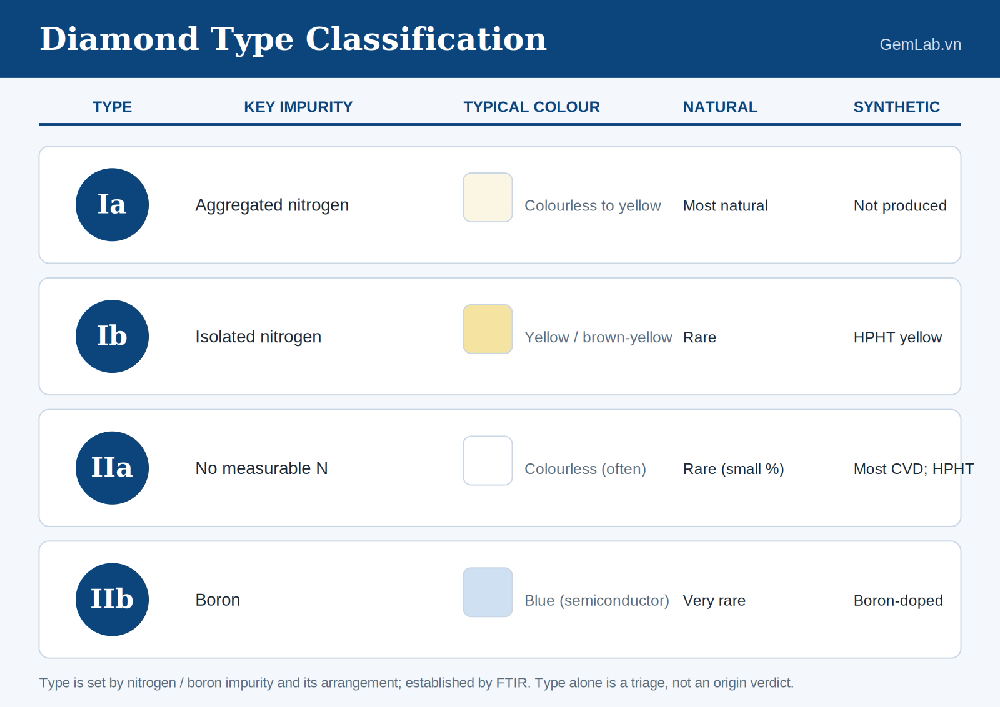
Type is not a verdict on its own. A natural Type IIa and a CVD Type IIa give the same FTIR signature. What type does is triage: it tells the laboratory which stones can be passed quickly and which must go to the imaging and luminescence stage. A colourless stone in the IIa or low-nitrogen range earns full scrutiny, because that is exactly where modern synthetics concentrate.
Natural vs HPHT vs CVD: how they grow
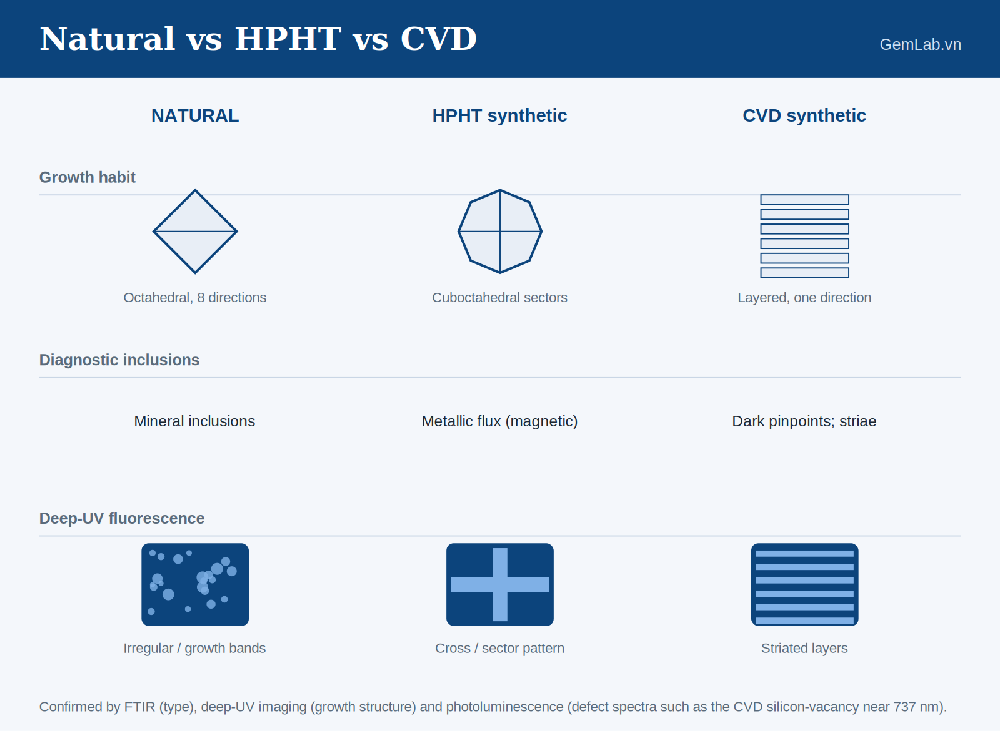
The decisive evidence of origin is recorded in how a crystal grew. Natural and synthetic diamonds form under different geometries, and those geometries leave permanent internal fingerprints — growth sectors, strain patterns and trace-element distributions — that survive cutting and polishing.
Natural diamonds crystallise deep in the Earth's mantle over geological timescales, growing in an octahedral habit (eight growth directions). Over their long residence they experience changing stress, which leaves a characteristic mottled or "tatami"-like strain pattern when viewed between crossed polarisers, and their nitrogen has time to aggregate (hence Type Ia).
HPHT synthetics are grown by the High Pressure High Temperature method, which reproduces mantle-like conditions in a press over days to weeks. The crystal grows from a molten metal flux (iron, nickel, cobalt), producing a cuboctahedral habit with multiple growth sectors. Two consequences are diagnostic: HPHT crystals can trap metallic flux inclusions, which appear dark and metallic in reflected light and can make the stone magnetic; and under deep-UV imaging they show a distinctive cross-shaped or geometric sector pattern. HPHT is also used as a treatment to improve the colour of both natural and CVD diamonds, which is itself a disclosable fact.
CVD synthetics are grown by Chemical Vapour Deposition, in which a carbon-bearing gas is broken down in a vacuum chamber and carbon deposits layer by layer onto a seed at moderate temperature and lower pressure. CVD diamonds grow essentially in one direction, producing flat layered growth and characteristic striations or growth rings rather than metallic inclusions. Because the chamber contains silicon, CVD material frequently carries a silicon-vacancy defect that is one of the strongest laboratory indicators of CVD origin. Fast-grown CVD can look brownish and is often given a post-growth HPHT treatment to improve colour.
| Feature | Natural | HPHT synthetic | CVD synthetic |
|---|---|---|---|
| Growth habit | Octahedral, 8 directions | Cuboctahedral, multiple sectors | Layered, one direction |
| Typical inclusions | Mineral inclusions | Metallic flux (can be magnetic) | Dark pinpoints, growth striae |
| Strain (crossed polars) | Strong mottled / tatami | Low or banded | Banded, layer-related |
| Deep-UV fluorescence | Irregular, blue, growth bands | Cross / sector pattern | Striated / layered pattern |
| Common type | Ia | Ib (yellow), IIa (colourless) | IIa |
The laboratory toolkit
No single test settles origin; a laboratory builds a case from converging evidence. Four instruments do most of the work.
Deep-ultraviolet fluorescence imaging — the technique most readers will know by the trade name DiamondView — excites the stone with very short-wavelength UV and photographs the resulting fluorescence. Because fluorescence maps internal growth structure, the images reveal the geometry described above: irregular, growth-banded patterns in natural stones; cross-shaped sector patterns in HPHT; and layered striations in CVD. Persistent glow after the lamp is switched off (phosphorescence) is itself a synthetic flag in many cases.
Photoluminescence (PL) spectroscopy at liquid-nitrogen temperature (about −196 °C) is the most sensitive origin tool. Cooling sharpens spectral lines so that defect "fingerprints" appear at part-per-billion levels. The nitrogen-vacancy centres at 575 nm (NV0) and 637 nm (NV−) and their relative behaviour inform the analysis, and the silicon-vacancy doublet near 736.6 and 736.9 nm is a strong indicator of CVD origin, because silicon enters the lattice from the deposition chamber. PL is the technique that catches well-made synthetics that pass every simpler test.
Fourier-transform infrared spectroscopy (FTIR) establishes type by reading nitrogen and boron absorption and the aggregation state of nitrogen. Boron absorption features near 2802 and 2928 cm−¹ identify Type IIb material, while the nitrogen region distinguishes aggregated (Ia) from isolated (Ib) nitrogen and confirms nitrogen-free (IIa) stones. FTIR is fast and is usually the first instrumental step.
Crossed polarisers reveal internal strain. Natural Type II diamonds typically show strong, mottled "tatami" birefringence accumulated over their long stressful history, whereas synthetics grown under steady conditions show weak or simply banded strain. This is an inexpensive screening observation, not a final proof, but it usefully sorts stones for deeper testing.
The reason a laboratory never rests on one instrument is that any single feature can be ambiguous. A colourless Type IIa stone could be a rare natural or a routine CVD; weak strain could mean a synthetic or simply a clean natural Type II; and a fluorescence pattern can be partly masked by post-growth treatment. Confidence comes from convergence: when FTIR type, deep-UV growth geometry, and the PL defect spectrum all point the same way, the conclusion is secure. Reputable laboratories also work blind to the stone's claimed origin and record each measurement, so the report reflects the evidence rather than the seller's description. For a buyer, that documented chain is exactly what separates a defensible origin call from a confident guess.
GemLab is candid about the boundary here. A full, defensible natural-versus-lab-grown determination requires the deep-UV imaging and cooled PL spectroscopy above. We are an independent coloured-stone laboratory; for diamond origin we will tell a client plainly when a stone needs to go to a laboratory equipped for these methods, rather than overstate what a screening setup can prove. That honesty is part of the service.
Why handheld testers fail on lab-grown
The pocket "diamond tester" sold to jewellers and pawnshops measures a physical property — usually thermal conductivity, sometimes combined with electrical conductivity for moissanite. Diamond conducts heat far better than glass or cubic zirconia, so a thermal tester reliably separates diamond from those simulants. A combined thermal-plus-electrical tester adds the ability to flag moissanite, which is electrically conductive in a way diamond is not.
But here is the trap: a lab-grown diamond is diamond. It has the same thermal conductivity, the same hardness, the same refractive index and the same electrical behaviour (for the same type) as a mined diamond. A handheld tester will therefore read "diamond" for both, exactly as it should — and it will tell you nothing about origin. The instrument is doing its job; it is simply answering a different question from the one a buyer of a natural stone needs answered.
This is the most expensive misunderstanding in the retail market: a pen tester "passing" a stone as diamond is routinely mistaken for proof that it is a natural diamond. It is not. The only reliable answer to origin is a laboratory report based on type, growth structure and luminescence, from a laboratory equipped to read them. When the price gap between natural and lab-grown is large, that report is not an optional extra — it is the asset you are actually paying for.
Related reading
This article is part of GemLab's identification cluster. To see where lab-grown diamonds sit among the four broad categories of stones in the market, read our guide to natural vs synthetic vs fake gemstones. For a worked example of the most common diamond simulant and how to separate it, see moissanite vs diamond. For how price, disclosure and resale differ between mined and lab-grown stones, see lab-grown vs natural diamond. To learn how to read the resulting report, see how to read a gem or diamond report. If you would like a stone examined and documented, GemLab offers an independent gemstone testing service.
Frequently asked questions
Can a lab-grown diamond be told apart from a natural one at all?
Yes — but not by eye and not by a handheld tester. The reliable separation relies on type analysis (FTIR), internal growth structure under deep-UV imaging, and photoluminescence spectroscopy at low temperature, all performed by an appropriately equipped laboratory.
Does a GIA-style 4C grade tell me if a diamond is natural?
No. The 4C describe colour, clarity, cut and carat — quality attributes that a lab-grown and a mined diamond can share identically. Origin is a separate determination that must be stated explicitly on the report.
What is the strongest single clue that a diamond is CVD-grown?
The silicon-vacancy defect detected by photoluminescence (a doublet near 736.6–736.9 nm) is a strong CVD indicator, because silicon enters the crystal from the deposition chamber. Layered growth striations and the absence of metallic inclusions support the conclusion.
Why does my diamond tester say "diamond" for a stone I suspect is lab-grown?
Because a lab-grown diamond really is diamond, with the same thermal and electrical properties the tester measures. The instrument correctly distinguishes diamond from simulants such as cubic zirconia or moissanite, but it cannot distinguish natural from synthetic origin.
Does GemLab issue natural-versus-lab-grown diamond reports?
GemLab is an independent coloured-stone laboratory and is transparent about the equipment a defensible diamond-origin call requires. We will screen a stone and advise clearly, and where deep-UV imaging or cooled photoluminescence is needed we will say so rather than overstate a result.