
A lab-grown diamond and a mined diamond of the same colour, clarity, cut and carat weight are the same material, sit side by side indistinguishably to the eye, and yet carry very different price tags. For a buyer that gap raises three practical questions that this article answers in order: why the prices differ, what the law and the trade require a seller to disclose, and what each choice means for the value you keep over time. None of these is a question of which stone is "real" — both are real diamond — but of supply, transparency and intent.
GemLab works primarily as an independent coloured-stone laboratory, and our interest here is not to push a buyer toward either choice. It is to make the trade-offs legible, because almost every dispute we see around diamonds comes down to a buyer who did not understand the difference between a quality grade and an origin statement. Once that distinction is clear, both natural and lab-grown diamonds become straightforward, honest purchases.
In This Article
- The same crystal, a different price
- Why the price gap exists
- Disclosure: the rules that make the market work
- Value retention and resale: a realistic view
- Proving which one you have
- Choosing between them: a buyer's framework
- Frequently asked questions
The same crystal, a different price
The single most important fact about a lab-grown diamond is that it is diamond. It has the same crystal structure, the same hardness of 10 on the Mohs scale, the same refractive index and dispersion, and the same chemical composition — pure crystallised carbon — as a stone pulled from the earth. This is what separates it sharply from a simulant such as cubic zirconia or moissanite, which only imitate the look of diamond. A lab-grown diamond is not an imitation; it is diamond produced by people rather than by geology.
Because the two are physically identical, the price difference is not a difference in quality. A laboratory-grown stone can earn the same top grades on colour, clarity and cut as a mined one, and in a blind comparison no jeweller can separate them by eye or with a handheld tester. The gap in price therefore reflects something outside the stone itself: how each one is supplied to the market, and how each one is perceived. Understanding that is the whole of the buying decision.
It helps to fix the vocabulary first, because loose language causes most of the confusion. "Natural" or "mined" means a diamond that crystallised in the earth's mantle over geological time. "Lab-grown", "laboratory-grown" or "synthetic" all mean the same thing: a diamond grown in a reactor, by either the HPHT or the CVD method. "Simulant" or "imitation" means a different material entirely that merely resembles diamond. A seller who blurs these terms — calling a synthetic "cultured" to imply it grew naturally, for instance — is the first warning sign in any transaction.
Why the price gap exists
Two stones that are chemically identical can be priced differently only because the chain that delivers each one to a shop window is different. The clearest way to see this is to follow each value chain from origin to counter.
A mined diamond reaches the market through a long and largely fixed pipeline. Suitable deposits are rare and finite, exploration is expensive and uncertain, and extraction moves enormous volumes of rock for a small yield of gem-quality crystals. That cost structure does not fall with technology in any rapid way; if anything the easy deposits are worked out first, so the marginal cost of new supply tends to rise over time. Supply is therefore constrained and relatively inelastic, which supports price.
A lab-grown diamond reaches the market through a manufacturing pipeline, and manufacturing behaves in the opposite way. Once a reactor design works, more reactors can be built, growth cycles shorten, yields improve and energy efficiency rises. Each of these pushes the cost of production down, and competition between producers passes those savings on. The result over the past decade has been a steady, sometimes steep, fall in lab-grown prices, while the underlying material remained identical. The market for the two has effectively decoupled: they are sold as different products even though they are the same substance.
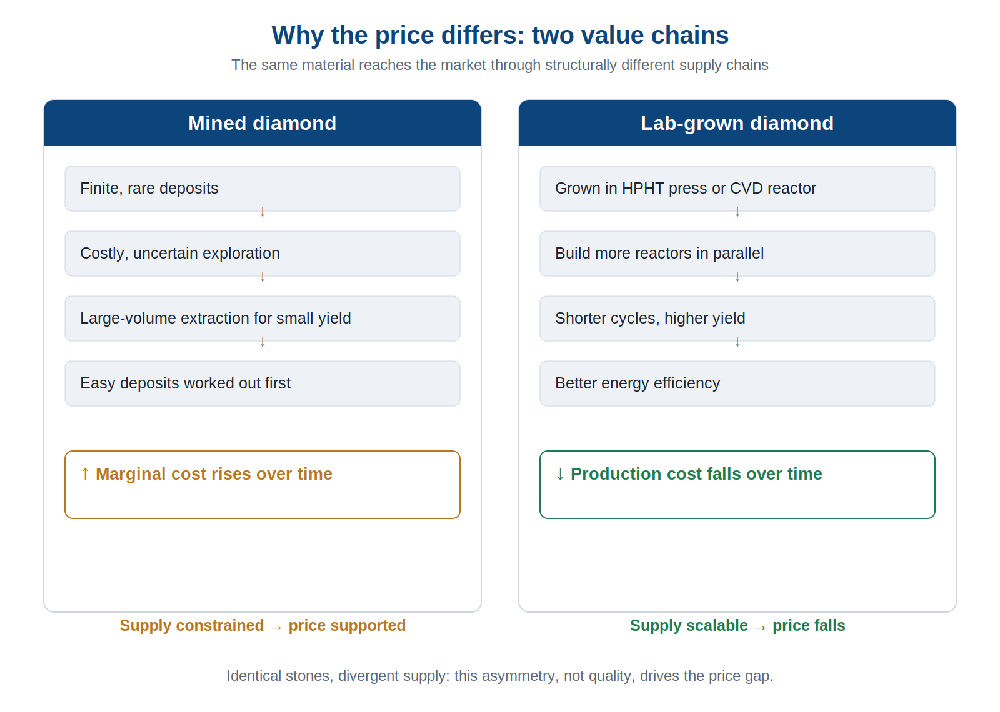
The two growth methods also shape the supply curve in their own ways. HPHT presses reproduce mantle-like pressure and temperature and have grown larger and more numerous, while CVD reactors deposit diamond layer by layer from a carbon gas and lend themselves to parallel scaling, with many chambers running at once. As both methods mature, average growth times fall and usable yields climb, and a producer that improves either step can undercut last year's prices. Mined supply has no equivalent lever: a miner cannot simply build another orebody. This asymmetry — manufacturing that gets cheaper against extraction that does not — is the engine behind the widening price gap, and it is why the gap has moved in one direction rather than fluctuating randomly.
On top of these structural forces sits perception. A mined diamond carries a scarcity and a heritage that many buyers value for its own sake, and that perceived rarity is part of what they are paying for. A lab-grown diamond offers the same optical performance without that scarcity premium, which is precisely its appeal to a different buyer. Neither valuation is wrong; they are simply answers to different questions. What matters is that the buyer knows which premium, if any, they are paying.
Disclosure: the rules that make the market work
Because a lab-grown and a mined diamond cannot be told apart by eye, the entire market depends on honest disclosure. The principle is consistent across the major trade frameworks: the word "diamond" on its own may be understood by a consumer to mean a natural stone, so a laboratory-grown diamond must be described with a clear qualifier such as "laboratory-grown", "lab-created" or "synthetic" wherever it is offered for sale. Abbreviations that a buyer might not understand, and euphemisms that imply natural origin, are not acceptable substitutes for plain disclosure.
This is not merely etiquette. In most consumer markets an undisclosed synthetic sold at a natural price is fraud, and the same logic applies to disclosing treatments on natural stones. The trade conventions maintained by bodies such as CIBJO, and consumer-protection guidance issued by national regulators, converge on the same requirement: origin and any treatment must be stated, in language the buyer will understand, before money changes hands.
For a buyer, the practical protection is a grading report from a recognised laboratory that states origin explicitly. A report that grades the 4C but is silent on whether the stone is natural or grown does not answer the origin question at all, and a stone of significant value should never be bought on a 4C grade alone. The report you want is the one that says, in plain terms, "natural" or "laboratory-grown", and for synthetics ideally the growth method as well.
Two further safeguards reinforce that report. Most graded diamonds carry a microscopic laser inscription on the girdle — a report number, and for synthetics often the word "lab-grown" — that lets a buyer match the physical stone to its document under magnification. And for natural stones, traceability schemes that record a diamond's journey from mine to retail are increasingly offered as evidence of provenance. Neither replaces the laboratory origin determination, but both make a claim harder to falsify, and their absence on a high-value stone is a reasonable prompt to ask more questions.
| What to look for | Acceptable | Warning sign |
|---|---|---|
| Origin wording | "Laboratory-grown" or "natural" stated plainly | "Cultured", "created gem", no statement at all |
| Report scope | Report states origin, not only 4C | 4C grade with origin left blank |
| Price vs claim | Price consistent with stated origin | Natural price, synthetic-style discount, vague answers |
| Laser inscription | Girdle inscription matching the report | Inscription absent or not matching |
Value retention and resale: a realistic view
This section is descriptive, not financial advice; it sets out how the two products have behaved so that a buyer can form their own expectations. A diamond of either origin is bought first to be worn, and treating any jewellery purchase as an investment is generally unwise.
With that said, the two products have behaved differently on resale. A mined diamond has an established second-hand market and a scarcity that, historically, has supported some residual value, though resale almost always returns well below the original retail price because retail margins and taxes do not transfer to a private seller. A lab-grown diamond sits in a market where new production cost has been falling, which puts downward pressure on the resale value of existing stones: a buyer reselling a lab-grown diamond competes against newer stones that cost less to make than theirs did. The honest summary is that neither should be expected to return its purchase price, and the lab-grown market in particular is still maturing, so resale expectations should be modest.
It is worth separating two numbers that buyers often confuse. Resale value is what a private seller can recover on the second-hand market, and it is modest for both origins. Replacement value is the figure an insurer uses to replace a lost stone with a like-for-like new one, and it sits closer to retail. A lab-grown diamond is cheaper to replace precisely because new equivalents are cheap, so its insured value tracks a falling market; a mined diamond's replacement value is anchored to a more stable retail price. A grading report matters here too, because an insurer or a future buyer can act only on documented, repeatable facts about the stone, not on a private description.
The constructive way to read this is not "natural is an investment" — it usually is not — but that the buyer should pay for the attribute they actually want. If the goal is the largest, brightest stone for a given budget, a lab-grown diamond delivers more carats and sparkle per unit of money, and resale is irrelevant to that goal. If the goal is the scarcity and heritage of a mined stone, that premium is the asset, and it should be bought with eyes open about resale. Matching the purchase to the motive is the entire skill.
Proving which one you have
Everything above assumes you can trust the origin claim, which returns the buyer to verification. The crucial and counter-intuitive point is that you cannot establish origin yourself. A handheld "diamond tester" measures thermal or electrical conductivity and will read "diamond" for both a mined and a lab-grown stone, exactly as it should, because both are diamond. It separates diamond from simulants, not natural from synthetic. No loupe, scale or pen tester resolves origin.
This has a concrete consequence for how a careful buyer should act. The time to settle origin is before the purchase, not after: ask for the laboratory report up front, confirm that it names a recognised laboratory, check that any girdle inscription matches the report number under magnification, and make sure the origin line reads plainly as natural or laboratory-grown. If a seller cannot produce such a report for a stone priced as natural, that absence is itself the most useful piece of information in the transaction. A report obtained afterwards can still confirm what you bought, but it can no longer change the price you agreed.
Reliable separation depends on laboratory instruments that read features a mined and a grown diamond do not share: type analysis by infrared spectroscopy, internal growth structure under deep-ultraviolet imaging, and photoluminescence spectroscopy at low temperature, which detects the defect signatures — such as the silicon-vacancy centre in CVD material — that betray a reactor origin. We set out how those instruments reason, and why they are necessary, in our companion guide to diamond testing: the 4C standard, diamond type and lab-grown detection. For the present purpose the takeaway is simple: when the price gap between natural and lab-grown is large, the laboratory report that proves origin is not an optional extra. It is the asset you are actually paying for.
Choosing between them: a buyer's framework
The choice becomes easy once it is framed as a question of priorities rather than of which stone is better. The two are the same material; the right answer is the one that matches what the buyer is trying to achieve.
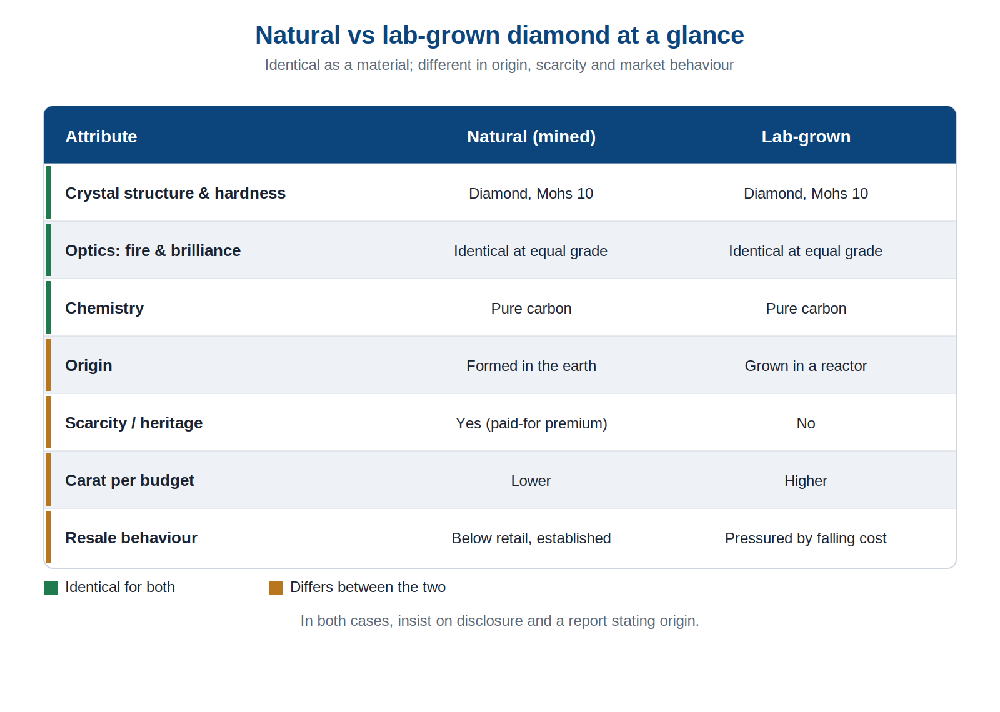
| Attribute | Natural (mined) | Lab-grown |
|---|---|---|
| Material and durability | Diamond, Mohs 10 | Diamond, Mohs 10 (identical) |
| Optics (fire, brilliance) | Identical at equal grade | Identical at equal grade |
| Carat per budget | Lower | Higher |
| Scarcity / heritage | Yes (a paid-for premium) | No |
| Resale behaviour | Established market, below retail | Maturing, pressured by falling new-build cost |
| Origin proof needed | Laboratory report | Laboratory report |
In short: choose a lab-grown diamond if you want the maximum visible stone for your money and are indifferent to scarcity; choose a mined diamond if the rarity and provenance matter to you and you accept the premium that carries. In both cases, insist on disclosure and a report that states origin, and you remove the only real risk in the transaction. The mistake is never choosing one or the other — it is paying a natural price for an undisclosed synthetic.
Related reading
To understand exactly how a laboratory proves a diamond's origin, read our guide to diamond testing: the 4C standard, diamond type and lab-grown detection. To see where lab-grown diamonds sit among the four broad categories of stones in the market, read natural vs synthetic vs fake gemstones, and for the most common diamond simulant and how to separate it, see moissanite vs diamond. For a field-by-field guide to the document itself, see how to read a gem or diamond report. If you would like a stone examined and documented, GemLab offers an independent gemstone testing service.
Frequently asked questions
Is a lab-grown diamond a real diamond?
Yes. It has the same crystal structure, hardness, optical properties and chemical composition as a mined diamond. It differs only in origin — grown in a reactor rather than formed in the earth — which is why it must be disclosed, not because it is an imitation.
Why is a lab-grown diamond cheaper if it is identical?
Because the two reach the market through different supply chains. Mined supply is finite and costly to extract, while lab-grown production scales with technology and has fallen in cost. The price gap reflects supply and perceived scarcity, not any difference in the stone's quality.
Can a jeweller or a diamond tester tell them apart?
No. A handheld tester reads "diamond" for both because both are diamond, and the eye cannot separate them at equal grade. Reliable origin determination requires laboratory instruments — FTIR, deep-UV imaging and low-temperature photoluminescence — not a pen tester.
Does a lab-grown diamond hold its value?
Generally less well than a mined stone, and neither should be expected to return its retail price. Falling production cost puts downward pressure on lab-grown resale, while mined stones have an established second-hand market but still sell well below retail. Buy for wear, not as an investment.
What must a seller disclose?
That the stone is laboratory-grown, in plain language, wherever it is offered. Terms like "cultured" that imply natural origin, or silence on the matter, are not acceptable. An undisclosed synthetic sold as natural is fraud.
What report should I ask for?
One from a recognised laboratory that states origin explicitly — natural or laboratory-grown — not merely a 4C quality grade. For high-value stones the origin statement, not the quality grade, is the document that protects you.