
From Luc Yen ruby to Central Highlands sapphire — presented from international peer-reviewed sources and field observation.
Vietnam is a genuine gemstone nation on the world map: Luc Yen ruby and spinel have been studied in depth by GIA, and Central Highlands sapphire is exported across international markets. But this is also one of the most noise-ridden of subjects — domestic sources are often unverified, while international sources quickly become outdated. This page maps the gemstones of Vietnam on a backbone of international peer-reviewed work (much of it co-authored by Vietnamese scientists themselves), separating fixed geological facts from volatile market information.
From a gemological standpoint, GemLab follows a clear principle: facts of formation, geology, and mineralogy are drawn from peer-reviewed journals (Gems & Gemology, Vietnam Journal of Earth Sciences, Mineralogical Magazine); production and market information is time-stamped and stated with explicit confidence. This is a content cluster built to become the most trustworthy reference in English on Vietnamese domestic gemstones.
Contents:
- Two geological environments behind Vietnamese gems
- Mining map by province
- Northern axis: Luc Yen & Quy Chau (marble-hosted)
- Southern axis: Central Highlands & Southeast (basalt-hosted)
- Identifying features & why origin matters
- Sources & GemLab's commitment
Two geological environments behind Vietnamese gems
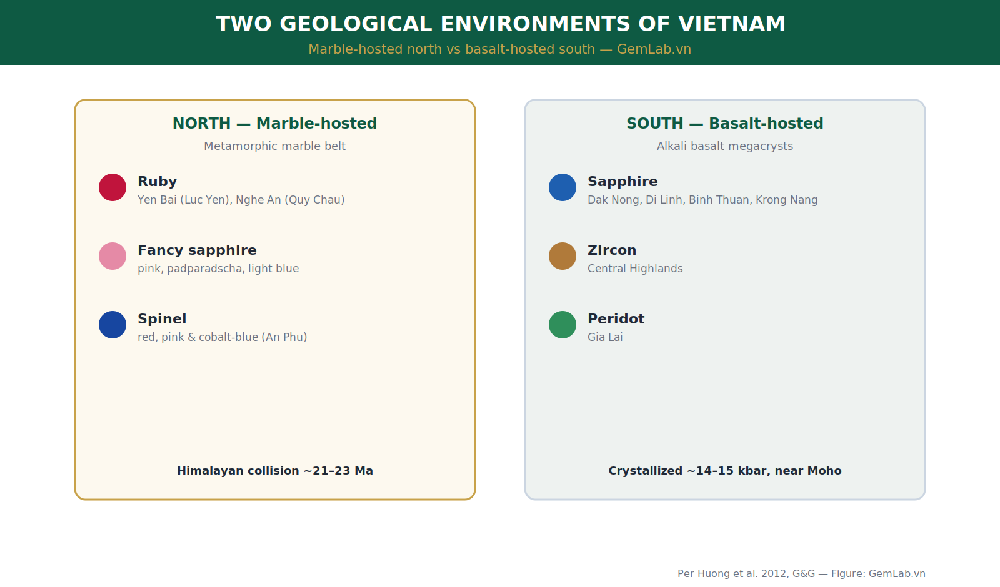
Vietnam's entire gem inventory was born from two completely different geological environments — and understanding this division is the key to understanding every Vietnamese stone:
Metamorphic marble environment (north). Ruby, fancy sapphire, and spinel in the north lie in marble — the product of amphibolite-facies metamorphism of carbonate rocks, associated with the Cenozoic India–Eurasia continental collision about 21–23 million years ago. This "marble-hosted ruby" mechanism is also the source of the precious ruby of Myanmar (Mogok) and Central–Southeast Asia.
Alkali basalt environment (Central Highlands & South). Blue, green, and yellow sapphire along with zircon and peridot in the south come instead from alkali basalt: they are crystals (xenocrysts/megacrysts) carried up from great depth by alkali basaltic magma — according to research from Dak Nong, the megacrysts crystallized in a magma chamber at about 14–15 kbar, near the Moho boundary (~50 km). This is the same formation type as the basaltic sapphire of Australia and Thailand.
This two-environment division is not just an academic detail — it explains why Vietnamese gemstones are so diverse. A single country rarely owns both geological "factories" for precious corundum: the Himalayan metamorphic belt extending down into the north yields marble ruby and spinel, while Cenozoic basaltic volcanism on the southern plateau yields sapphire. Because the two mechanisms differ, the two regions produce stones with very different optical properties, inclusions, and colors, and "Vietnamese gemstones" cannot be treated as a single uniform block.
| Criterion | Marble-hosted (North) | Basalt-hosted (South) |
|---|---|---|
| Host rock | Metamorphosed marble | Alkali basalt & weathering layer |
| Main gems | Ruby, fancy sapphire, spinel | Blue/green/yellow sapphire, zircon, peridot |
| Mechanism | Amphibolite-facies metamorphism | Megacrysts from deep basaltic magma |
| Characteristic colors | Red, pink, multicolor fancy | Deep blue to green–yellow |
| Representative areas | Yen Bai, Nghe An | Dak Lak, Dak Nong, Lam Dong, Dong Nai |
Mining map by province
According to a GIA overview (Huong et al., 2012), Vietnam has about 14 significant gem provinces. The table below summarizes the distribution by gem type and province — a quick reference map:
| Gemstone | Main mining areas |
|---|---|
| Ruby | Yen Bai (Luc Yen, Yen Binh); Nghe An (Quy Chau, Quy Hop) |
| Sapphire | North: Yen Bai, Nghe An (fancy); South: Dak Lak, Dak Nong, Lam Dong, Dong Nai, Binh Thuan (blue/green/yellow) |
| Spinel | Yen Bai (Luc Yen, An Phu — including cobalt-blue spinel); Central Highlands |
| Tourmaline & garnet | Yen Bai (Luc Yen) |
| Peridot | Gia Lai (Central Highlands) |
| Zircon | Central Highlands |
| Aquamarine (beryl) | Thanh Hoa, Khanh Hoa |
| Pearl (cultured) | Ha Long Bay, coastal areas (akoya, freshwater pearl) |
A note on timeliness: the mining status of each deposit changes over time. Some sources record Yen Bai as currently the main active spinel area, but this is production information that needs updating from the latest field surveys, unlike geological facts, which are fixed. GemLab clearly distinguishes between these two kinds of information.
Northern axis: Luc Yen & Quy Chau (marble-hosted)
Luc Yen (Yen Bai) has been Vietnam's most important gem center since gems were discovered there in 1987. The area lies in the Lo Gam zone of the Red River shear zone system, with Cambrian-age metamorphosed sediments including marble and sillimanite–biotite–garnet schist. Luc Yen yields ruby, sapphire, spinel (red, pink, and especially the rare cobalt-blue spinel of the An Phu area), along with gem-quality tourmaline and feldspar. The Yen The gem market is one of the country's liveliest gem trading spots.
What makes Luc Yen special on the world map is the rare co-occurrence of many gem types in the same geological setting: in placer deposits, blue spinel is often found together with ruby, red spinel, sapphire, and tourmaline — sometimes a single placer batch yields thousands of carats of small but highly saturated blue spinel. Here ruby and red spinel share the same paragenesis, while blue spinel is linked to forsterite, reflecting different metamorphic histories within the same area — a detail of particular interest to international researchers.
A valuable scientific detail: spinel from different Luc Yen mines has a distinct trace-element "fingerprint." According to Pham Van Long et al. (2018), spinel from the Cong Troi area has very low zinc content (below ~500 ppm) and high iron, while spinel from the An Phu area is zinc-rich (up to ~11,000 ppm) — a difference that allows source discrimination within a single district.
Quy Chau (Nghe An) is the second important ruby area, linked to the Quy Chau shear zone on the eastern edge of the Bu Khang dome. Quy Chau ruby has yielded vivid red stones that are highly sought after. Dating research shows that ruby from this area formed during the Miocene (cooling ~21–22.5 million years ago), consistent with the metamorphic ruby model tied to Cenozoic tectonics across the entire belt.
A notable dating fact: zircon enclosed in Quy Chau ruby gives a U–Pb age of about 53.8 million years, while ruby in the Red River shear zone formed later under peak metamorphic conditions. These numbers are not just academic detail — they place Vietnamese gemstones in their proper regional tectonic context, stretching from Afghanistan to Vietnam, and are the kind of evidence that only peer-reviewed research can provide, quite unlike word-of-mouth market information.
Read in depth: Luc Yen ruby and Luc Yen spinel.
Southern axis: Central Highlands & Southeast (basalt-hosted)
Quite unlike the northern axis, the southern provinces yield basaltic-type sapphire in large volume. Dak Nong and Di Linh (Lam Dong) are famous for deep blue sapphire; Binh Thuan and Krong Nang (Dak Lak) lean toward green and yellow-green tones. Most basaltic sapphire is heated to improve its color — a reality that requires transparent disclosure. The region also occasionally yields rare trapiche sapphire.
Basaltic sapphire comes with a whole suite of associated gems: zircon (yellow-brown, blue after heating), Gia Lai peridot (which, according to research, crystallized at 910–980°C at about 60 km depth, from a spinel lherzolite source), along with garnet, augite, and hyalite opal. Seven new gem occurrences have also been recorded in the basalt region of the Southeast (Dong Nai, Ba Ria–Vung Tau).
This north–south division has a direct identification consequence: a deep-blue "basaltic-type" sapphire with characteristic inclusions is more likely to belong to the southern axis, while fancy sapphire occurring with ruby in a marble setting belongs to the northern axis — a laboratory reads this through inclusions and trace elements.
It is worth dwelling on how rare this double endowment is. Most gem-producing nations are defined by a single signature stone and a single geology — Colombia by its emerald, Tanzania by its tanzanite, Australia by its basaltic sapphire and opal. Vietnam instead spans two of the planet's great corundum systems at once, which is why its gem map reads less like a single deposit and more like a continent in miniature. For a buyer, the lesson is practical: the phrase "Vietnamese gem" tells you little until you know which of the two worlds the stone came from, because that single fact reshapes its color, its inclusions, and the questions a laboratory must ask of it.
This reality also opens an opportunity for Vietnamese gem enthusiasts: domestic sapphire and spinel, when tested and transparently disclosed as to origin and treatment status, can compete on a level field in the international market — something only an independent testing platform with deep knowledge of domestic geology can support.
Identifying features & why origin matters
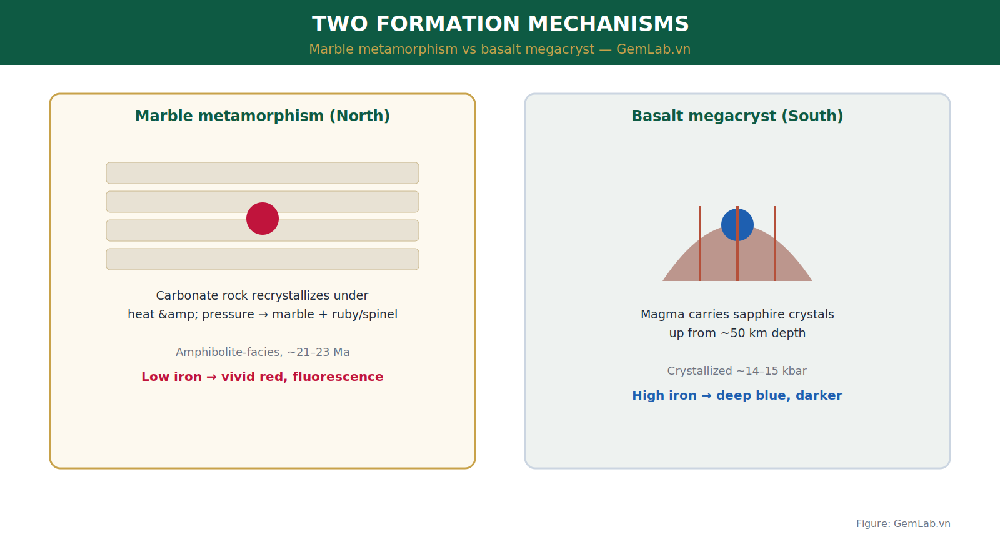
Why does origin determination matter? Because geographic origin directly affects value, and each area leaves its own "fingerprint" that a laboratory reads through two channels: inclusions (accompanying minerals, growth style) and trace elements (ratios of Fe, Zn, Cr, V, Ti…). As noted, it is the zinc–iron ratio that distinguishes Cong Troi spinel from An Phu; similarly, marble-hosted and basalt-hosted sapphire differ clearly in trace-element profile and inclusions.
However, one must be honest about limits: a high-level origin conclusion (distinguishing a specific mining area, or Vietnam from Myanmar) usually requires trace-element instrumentation such as LA-ICP-MS — beyond the reach of basic gemological equipment. GemLab identifies the gem species and the features observable on site, and states clearly when an origin conclusion would require specialized analysis. Learn more about GemLab's gemstone testing service.
Sources & GemLab's commitment
Vietnamese gemstones are a subject riddled with misinformation and rumor. GemLab commits to a clear sourcing methodology to make this page trustworthy: geological, mineralogical, and identification facts are drawn from international peer-reviewed work — notably, much of it co-authored by Vietnamese scientists themselves (Pham Van Long, Le Thi Thu Huong, Nguyen Ngoc Khoi…) in Gems & Gemology and Vietnam Journal of Earth Sciences, combining international rigor with field knowledge.
Information on production, "active mines," or prices is treated as time-stamped data: GemLab states the date and confidence level, and does not elevate market rumor into fact. Most importantly, GemLab adds its own layer of data — direct observation of genuine Vietnamese specimens with gemological instruments — so that this cluster does not merely compile literature but also carries primary value. That is how GemLab builds the most trustworthy English reference on Vietnamese gemstones.
Reference standards: Huong L.T. et al. (2012) "Gemstones from Vietnam: An Update", Gems & Gemology 48(3); Pham Van Long, Pardieu, Giuliani (2014) "Update on Gemstone Mining in Luc Yen", G&G 49(4); Pham Van Long et al. (2018) trace elements & oxygen isotopes of Luc Yen–An Phu spinel, Vietnam Journal of Earth Sciences; Vu D.T.A. et al. (2020) inclusions in basaltic sapphire of southern Vietnam, G&G; Garnier et al. (2005, 2008). Geological data is stable; production/market information may change over time.
Frequently asked questions
What gemstones is Vietnam best known for? Most notably Luc Yen ruby and spinel (Yen Bai) and Quy Chau ruby (Nghe An) in the marble environment; together with sapphire, zircon, and peridot of the Central Highlands and South in the basalt environment. There are also tourmaline, garnet, aquamarine, and cultured pearl.
How does Luc Yen ruby differ from Thai basaltic ruby? Luc Yen ruby is marble-hosted (formed in metamorphic marble), usually with vivid red color and strong fluorescence; this differs from basaltic-type ruby, which is darker. The difference shows in inclusions and trace elements.
Is Vietnamese cobalt-blue spinel real? Yes. Rare cobalt-blue spinel is found in the An Phu area (Luc Yen) and is highly valued by international collectors. It is one of Vietnam's most valuable colored stones.
Is Central Highlands sapphire heated? Most basaltic sapphire (Dak Nong, Di Linh, Binh Thuan…) is heated to improve color — a common treatment that needs disclosure. An unheated stone of fine color is rarer and more valuable.
Can a stone be confirmed as coming from Vietnam? A laboratory can offer an opinion based on inclusions and trace elements, but a high-level origin conclusion usually requires instrumentation such as LA-ICP-MS. GemLab identifies the gem species and observable features, and states clearly when specialized analysis is needed.
Explore further: Luc Yen ruby, Luc Yen spinel, and Vietnam sapphire form the rest of this Vietnamese gemstones cluster. For species reference, see the ruby, sapphire, spinel, peridot, and zircon pages. For testing, see GemLab's gemstone testing service.
Explore the Vietnamese gemstones cluster
Continue with the in-depth spoke pages of this cluster: Luc Yen ruby, Luc Yen spinel, and Vietnam sapphire. To have a stone examined, see GemLab's gemstone testing service. For the method behind telling stones apart, see natural vs synthetic vs fake gemstones.