
Sapphire is the gemstone that most clearly reveals Vietnam's unique "geological duality": the same blue corundum mineral, yet the north and the south yield two streams of sapphire that differ entirely in origin, color, and character. The high-volume deep-blue sapphire of the Central Highlands and South arises from volcanic basalt, while the multicolor fancy sapphire of Yen Bai and Nghe An forms in marble together with ruby. This article presents the gemology of both streams of Vietnamese sapphire, their identifying features, the question of heat treatment, and what it means for buyers.
This is an in-depth page within the Vietnamese gemstones cluster; the general properties of the species are covered on the sapphire reference page. From a gemological standpoint, GemLab follows the peer-reviewed publications of GIA (Gems & Gemology).
Contents:
- Two streams of Vietnamese sapphire
- Basaltic sapphire of the Central Highlands & South
- Fancy marble sapphire of the north
- Identifying features & inclusions
- Heat treatment & value
- Testing Vietnamese sapphire
Two streams of Vietnamese sapphire
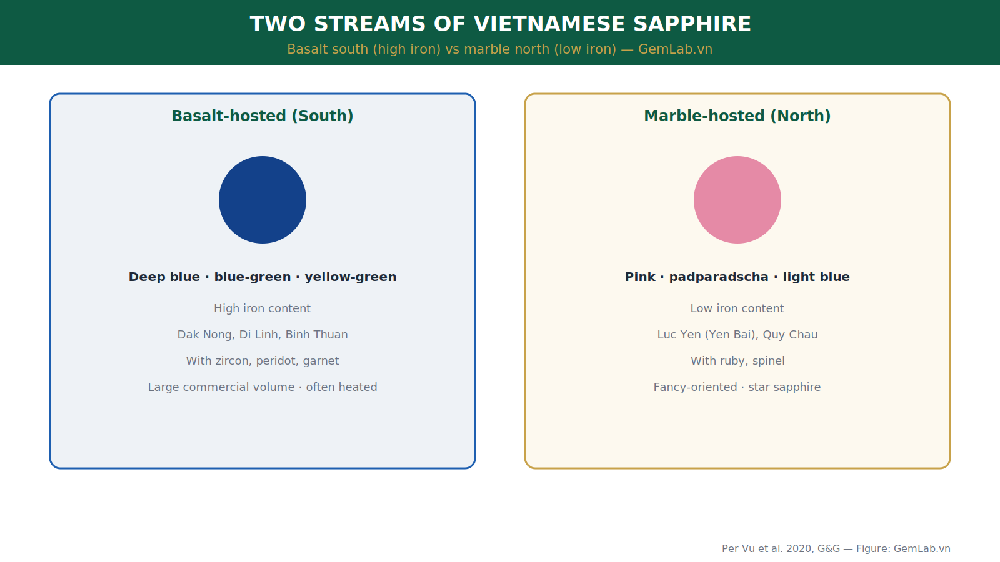
Unlike many countries that have only one type of sapphire deposit, Vietnam possesses both corundum-forming environments — and this is the key to understanding every Vietnamese sapphire:
| Criterion | Basalt-hosted (South) | Marble-hosted (North) |
|---|---|---|
| Representative areas | Dak Nong, Di Linh, Binh Thuan, Krong Nang | Luc Yen (Yen Bai), Quy Chau (Nghe An) |
| Iron content | High | Low |
| Characteristic colors | Deep blue, blue-green, yellow-green | Fancy: pink, padparadscha, light blue |
| Associated with | Zircon, peridot, garnet | Ruby, spinel |
| Supply volume | Large (commercial) | Smaller, fancy-oriented |
This division is no minor point: iron content — high in basalt, low in marble — governs the stone's color, vividness, and spectroscopic character, and is the basis for how a laboratory groups corundum.
More specifically, in the laboratory corundum is usually divided into two groups by iron chemistry: the low-iron group (including northern marble sapphire) and the high-iron group (including southern basaltic sapphire). This grouping not only helps describe color but also guides the entire subsequent testing process — from reading the absorption spectrum to interpreting inclusions — because each group has its own internal "grammar."
Few people notice that this "duality" makes Vietnam a geological laboratory in miniature. Within a single country, one can directly compare the two most important corundum-forming mechanisms on the planet — marble metamorphism and crystallization from basaltic magma — something very few places on Earth can offer. For the collector, this means "Vietnamese sapphire" is never a single concept: one must always ask "which region, which deposit type," and the answer determines both the appearance and the scientific profile of the stone.
Basaltic sapphire of the Central Highlands & South
Since the late 1980s, the southern sapphire mines have supplied large volumes to the jewelry industry. According to GIA (Vu et al., 2020), the four main mining areas are Dak Nong, Di Linh (Lam Dong), Binh Thuan, and Krong Nang (Dak Lak). The finest deep-blue sapphire comes from Dak Nong and Di Linh, while Binh Thuan and Krong Nang lean toward blue-green and yellow-green tones. The area occasionally yields rare trapiche sapphire too.
As to formation, this is classic basaltic-type sapphire: the crystals are carried up from great depth by alkali basaltic magma. Petrological research from Dak Nong shows that the megacrysts crystallized in a magma chamber at about 14–15 kbar (near the Moho boundary at ~50 km), from an iron-rich syenitic melt with the involvement of CO₂ and carbonate fluids. This iron-rich origin explains why basaltic sapphire often has deep-blue to blue-green tones and is darker than marble sapphire. According to GIA, the mineral inclusions in southern Vietnamese sapphire evolved from an alkali-felsic assemblage — a formation "fingerprint."
An interesting point about age: the zircon accompanying basaltic sapphire is a valuable dating tool. Trace-element analysis together with U–Pb isotopes of zircon in southern Vietnamese sapphire has been used as an indicator for the basalt-related sapphire formation model — the kind of quantitative evidence that only peer-reviewed research can provide, and a basis for distinguishing Vietnamese basaltic sapphire from other basaltic sources worldwide.
Most basaltic sapphire is mined from placer deposits (eluvial, alluvial) of late Pleistocene to Quaternary age, by both artisanal and mechanized operations.
The diversity of mining areas creates a very wide quality range: from high-quality deep-blue sapphire suitable for multi-carat center stones, to commercial yellow-green sapphire in large quantities. A mining history dating from the late 1980s placed Vietnamese sapphire in the international jewelry supply chain quite early, and it remains a significant regional source of basaltic-type corundum to this day.
Fancy marble sapphire of the north
In the north, sapphire forms not from basalt but from metamorphic marble — the same geological setting as Luc Yen ruby and spinel. Because the marble is iron-poor, northern marble sapphire leans toward fancy colors rather than deep blue: pink, padparadscha (a lotus-like pink-orange), and light blue. This region also yields cabochon-grade star sapphire, especially in the Tan Huong–Truc Lau area.
An interesting identifying feature of northern marble corundum: Vietnamese pink sapphire sometimes shows a "haze" with a faint orange glow, due to inclusions such as calcite and apatite — the very accompanying minerals that confirm a marble-hosted origin, just as in Luc Yen ruby. Padparadscha is the rarest and most precious shade in this group, especially sought after by Asian collectors.
The geological similarity between northern marble sapphire and Luc Yen ruby and spinel is no coincidence — all three formed in a single metamorphic event, differing only in their color-causing element combination. The practical consequence: in a single Luc Yen placer batch, one may encounter red ruby, red spinel, and pink sapphire side by side — and distinguishing them (corundum or spinel, ruby or pink sapphire) is a core reason for testing, because the color boundary directly determines the name and the value.
This is where a laboratory with deep knowledge of domestic geology has an advantage: rather than reading an isolated stone, GemLab places it in the proper Vietnamese origin context — knowing that a "hazy, orange-glow" pink stone may well be northern marble sapphire, or that a deep-blue stone with strong color zoning is likely Central Highlands basalt — to direct the tests efficiently.
Identifying features & inclusions
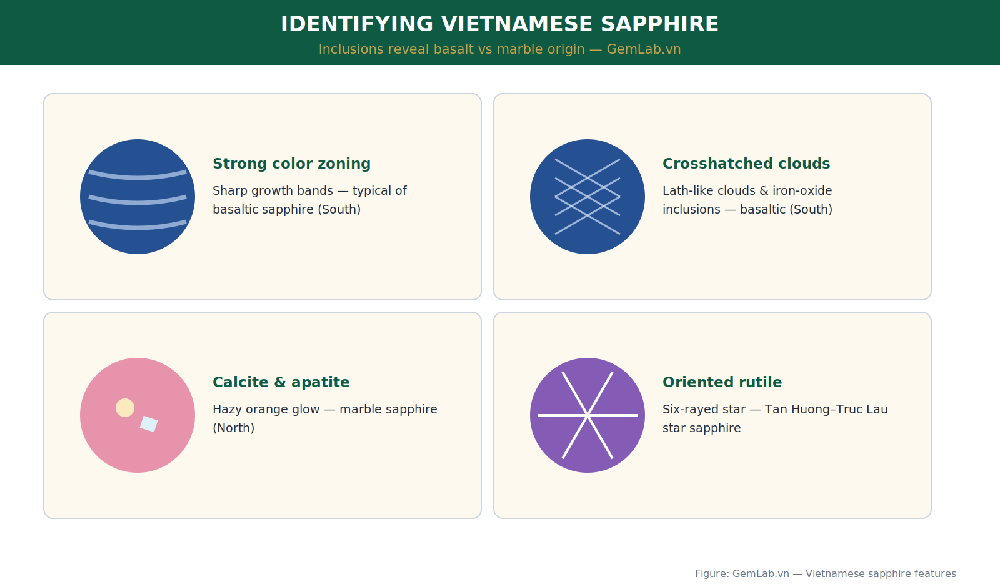
The two sapphire streams leave different internal features that a laboratory reads under the microscope:
| Feature | Commonly seen in |
|---|---|
| Strong color zoning, clear growth structure | Basaltic sapphire (South) |
| Crosshatched / lath-like "clouds", iron-oxide inclusions | Basaltic sapphire (South) |
| Calcite, apatite inclusions; "hazy" orange glow | Marble sapphire (North) |
| Oriented rutile network → six-rayed star | Star sapphire (Tan Huong–Truc Lau) |
Vietnamese basaltic sapphire shows prominent growth structures, characteristic color zoning, crosshatched to lath-like "clouds," and many mineral inclusions — according to GIA surveys of hundreds of faceted samples from the Phan Thiet and Di Linh areas. These features, combined with iron-rich chemistry, help distinguish basaltic sapphire from iron-poor marble sapphire — and further, assist in distinguishing it from sapphire of international sources.
The limit must be stated right here: although these features are useful, basaltic sapphire worldwide (Thailand, Australia, Cambodia, East Africa) shares many features due to the same formation mechanism, so confirming that a specific basaltic sapphire comes from Vietnam rather than another country is a difficult origin problem, requiring inclusions to be combined with trace-element chemistry. For this reason a serious origin conclusion always rests on multiple lines of evidence, and sometimes must still be expressed as "consistent with" rather than an absolute determination.
Heat treatment & value
A reality requiring transparency: most Vietnamese basaltic sapphire is heated to improve color. Blue-green or dark sapphire may be heated for a fresher, cleaner blue; yellow sapphire is also commonly heat-treated. This is a common treatment, accepted by the market when disclosed — but it must be disclosed. The mechanism of corundum heating is presented in detail on the heat-treated gemstones page.
As to value, Vietnamese sapphire spans many segments: from accessible commercial basaltic sapphire, to high-quality deep-blue Dak Nong–Di Linh stones, to rare padparadscha and star sapphire. GemLab does not quote specific prices because they vary with color, clarity, size, and treatment status. The deciding factors are always: fine color, honestly disclosed heating status, and a trustworthy report. An unheated sapphire of fine color is always rarer and commands a price well above an equivalent heated stone.
The gap between heated and unheated deserves emphasis, because it is where most value is won or lost. Heating is a legitimate, long-accepted process, and a well-heated stone can be beautiful and fairly priced — there is nothing wrong with it when disclosed. The problem arises only when the treatment is hidden, because an unheated stone of the same color can be worth several times more. This is precisely why a report stating treatment status is not a formality but the single document that protects both buyer and seller, and why GemLab treats the heated/unheated determination as one of the most consequential lines on a sapphire report.
For Vietnamese people, domestic sapphire carries a special appeal: a Dak Nong blue sapphire or a Luc Yen padparadscha is an internationally class gemstone mined on one's own soil. When independently tested and transparently disclosed as to treatment, these stones are fully qualified to compete in the regional market — and that is how to raise the value of Vietnam's gem resources, rather than letting them flow abroad as anonymous rough.
Testing Vietnamese sapphire
For sapphire, testing answers these questions: whether the stone is natural sapphire (distinguishing it from the very common synthetic sapphire), its treatment status (unheated / heated / diffusion / glass-filled), and origin clues. The origin question for sapphire carries an extra challenge: northern Vietnamese marble sapphire, like Luc Yen ruby, belongs to the low-iron group and can overlap in features with other marble sources; while basaltic sapphire shares features with the basaltic sapphire of Thailand, Australia, and Cambodia.
Like every high-level origin conclusion, this usually requires trace-element analysis by LA-ICP-MS. GemLab identifies the gem species, assesses treatment status and observable features on site, and states clearly when a conclusion requires specialized instrumentation. See GemLab's gemstone testing service.
Reference standards: Vu D.T.A. et al. (2020) "Mineral Inclusions in Sapphire from Basaltic Terranes in Southern Vietnam", Gems & Gemology Winter 2020 (four areas Dak Nong/Di Linh/Binh Thuan/Krong Nang, alkali-felsic source, common heating); Smith C.P. et al. (1995) "Sapphires from Southern Vietnam", G&G Fall 1995 (growth structures, crosshatched clouds); Garnier et al. (2005) Dak Nong petrology (megacrysts 14–15 kbar); Huong L.T. et al. (2012) "Gemstones from Vietnam", G&G 48(3). Market information is time-sensitive.
Frequently asked questions
How many types of Vietnamese sapphire are there? Two main streams: basaltic sapphire (Dak Nong, Di Linh, Binh Thuan, Krong Nang) in deep blue to blue-green and yellow-green tones; and northern marble sapphire (Yen Bai, Nghe An) leaning toward fancy pink, padparadscha, and star sapphire.
Is Central Highlands sapphire heated? Most basaltic sapphire is heated to improve color — a common treatment that needs disclosure. An unheated stone of fine color is rarer and commands a significantly higher price.
Why is basaltic sapphire usually darker? Because of its iron-rich origin: iron makes the blue deeper and darker, and also affects spectroscopic features. Iron-poor marble sapphire leans toward lighter, fresher fancy colors.
Is Vietnamese padparadscha real? Yes. The northern marble region (Luc Yen) is one of the rare sources of padparadscha — a lotus-like pink-orange, among the rarest and most precious of sapphires.
Can a sapphire be confirmed as coming from Vietnam? A laboratory can offer an opinion based on inclusions and trace elements, but because of overlap with other marble and basalt sources worldwide, a confident origin conclusion usually requires specialized LA-ICP-MS analysis.
How does Vietnamese star sapphire form? The star effect (asterism) arises from an oriented rutile network along three directions in the corundum crystal, reflecting light into a six-rayed star. Cabochon-grade star sapphire and star ruby from Vietnam are concentrated in the Tan Huong–Truc Lau area (Yen Bai), often with clear growth zoning.
Own a Vietnamese sapphire? Have it tested before any transaction. An independent laboratory specializing in Vietnamese colored stones identifies species, heating status, and characteristics, and is transparent about limitations. See GemLab's gemstone testing service.
Explore the Vietnamese gemstones cluster
This page is part of GemLab's Vietnamese gemstones cluster. Continue with the related in-depth pages: Vietnamese gemstones overview, Luc Yen ruby, and Luc Yen spinel. To have a stone examined, see GemLab's gemstone testing service. For the method behind telling stones apart, see natural vs synthetic vs fake gemstones.