
Luc Yen ruby is the pride of Vietnam's colored-stone industry — and one of very few domestic gems studied by the international gemological community and compared directly with the legendary Mogok ruby of Myanmar. Born in the iron-poor marble of Yen Bai province, Luc Yen ruby possesses a vivid red color and the characteristic "glow" of the world's finest ruby family. This article presents the gemology of Luc Yen ruby: why it glows, how to identify it, and why determining its geographic origin is a fascinating challenge even for a leading laboratory.
This is an in-depth page within the Vietnamese gemstones cluster; the general properties of the species are covered on the ruby reference page. From a gemological standpoint, GemLab follows the peer-reviewed publications of GIA and Vietnamese geological literature.
Contents:
- Luc Yen on the world ruby map
- Why Luc Yen ruby "glows"
- Identifying features & inclusions
- Luc Yen vs Mogok: the origin problem
- Treatment, "pigeon's blood" & value
- Testing Luc Yen ruby
Luc Yen on the world ruby map
Ruby was discovered at Luc Yen, in Yen Bai province, in 1987, and within just a few decades it placed Vietnam among the world's sources of high-quality ruby. What determines that standing is the mode of formation: Luc Yen ruby is marble-hosted — formed in metamorphosed marble, the same geological family as Mogok ruby (Myanmar) and the Hindu Kush region. This is the geological lineage that produces the purest and most vivid red rubies on the planet.
Geologically, the Luc Yen deposits lie within the Lo Gam zone of the Red River shear zone system, in metamorphosed sediments of Cambrian age. The ruby formed through amphibolite-facies metamorphism associated with the Cenozoic India–Eurasia continental collision about 21–23 million years ago — the same tectonic event that created the entire marble ruby belt stretching from Afghanistan to Southeast Asia. Along this same belt lie Mogok (Myanmar), Hunza (Pakistan), and the Tajikistan deposits — all of them offspring of the great continental collision that raised the Himalaya. Most Luc Yen ruby today is recovered by small-scale artisanal miners from placer deposits and ore pockets within the limestone mountains.
This artisanal mode of mining, beyond its economic significance for rural communities, leaves its mark on the stone itself: Luc Yen ruby is often recovered from placers after natural transport, so many stones have abraded surfaces and need cutting to reveal their beauty. This is also why the Luc Yen market spans a wide range of quality — from rough at cabochon grade to clear, fine-colored stones that meet faceting standards — and why a top-grade, certified Luc Yen stone is so valuable: it is the apex of a very broad quality spectrum.
Why Luc Yen ruby "glows"
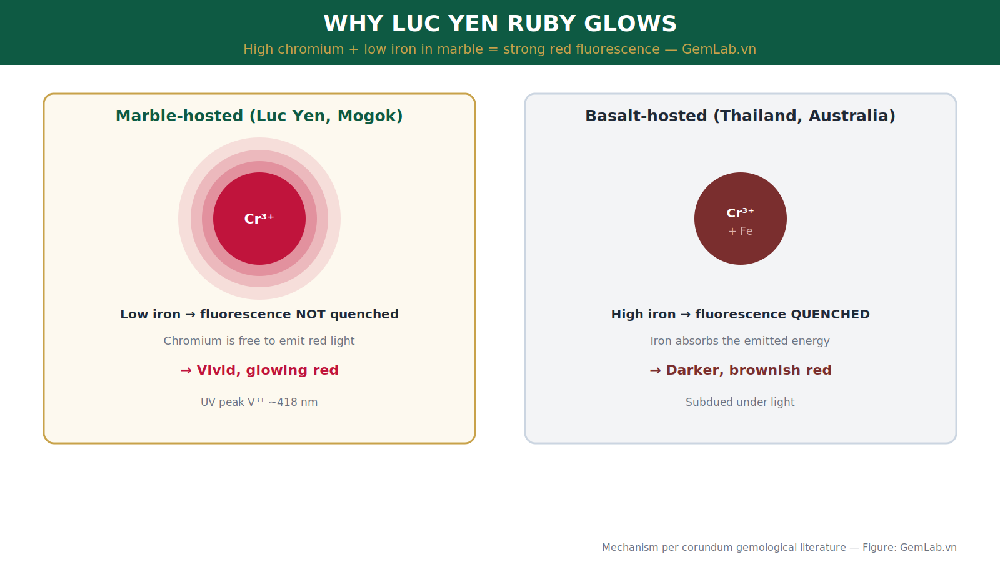
The "glow" (red fluorescence) is the core value and the most recognizable feature of marble-hosted ruby. The mechanism lies in color chemistry: the red color of ruby is created by the element chromium (Cr³⁺), and chromium also fluoresces red under ultraviolet light as well as under UV-rich daylight. But this fluorescence is quenched by iron (Fe). Because the Luc Yen marble is very poor in iron, the chromium is free to "shine" — the stone appears to burn with an inner fire even in weak light.
This is precisely the key dividing line between the world's two ruby families. The table below compares them:
| Criterion | Marble-hosted (Luc Yen, Mogok) | Basalt-hosted (Thailand, Australia) |
|---|---|---|
| Iron content | Low | High |
| Red fluorescence | Strong — "glowing" | Quenched |
| Red color | Vivid, pure red, up to "pigeon's blood" | Darker, brownish or purplish |
| Visual vividness | High | More subdued |
One spectroscopic detail: marble-hosted ruby typically shows a characteristic ultraviolet absorption peak around 418 nm related to the vanadium ion (V³⁺) — one of the spectral signatures laboratories use when analyzing metamorphic corundum.
For the buyer, this fluorescence has a very practical meaning. Because daylight contains ultraviolet, a strong red fluorescence makes the stone appear to intensify in sunlight rather than wash out — the opposite of how an iron-rich, basalt-hosted ruby behaves. A simple long-wave UV lamp will reveal this glow clearly, and while it is not a substitute for laboratory analysis, it is one of the first observations a gemologist records when a stone is presented as Vietnamese or Burmese ruby. The strength and color of the fluorescence, read together with the body color, already narrows the field considerably before any advanced instrument is brought in.
Identifying features & inclusions
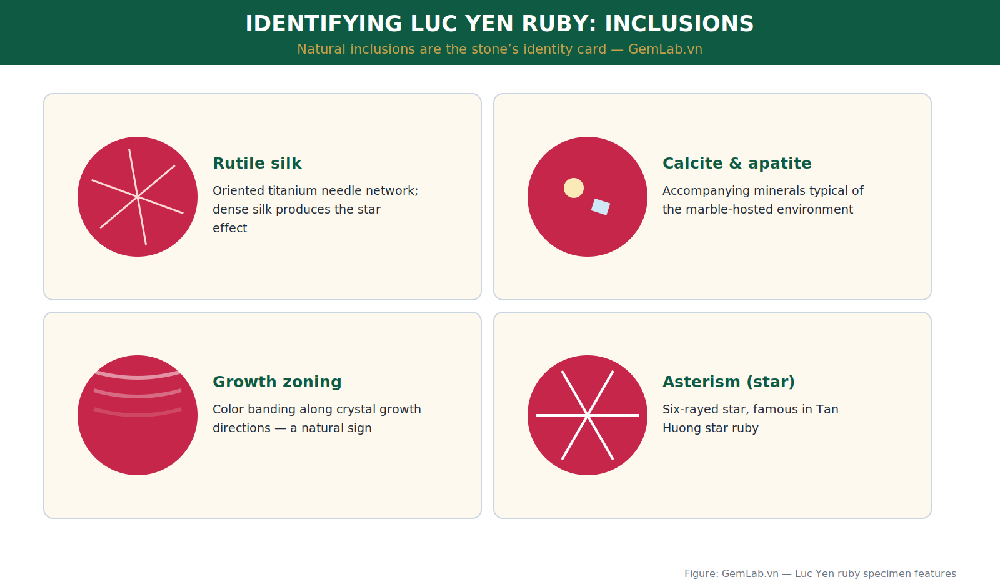
Like every natural ruby, Luc Yen ruby carries inclusions — not flaws, but a natural "identity card" recording its history of formation. The common features are:
| Feature | Identification significance |
|---|---|
| Rutile needles (silk) | Titanium network; when dense and oriented, produces the star effect |
| Calcite and apatite crystals | Typical accompanying minerals of the marble (marble-hosted) environment |
| Growth zoning | Color banding along crystal directions, a natural sign |
| Asterism (star effect) | Six-rayed star — famous in the star ruby of the Tan Huong area |
The Tan Huong–Truc Lau area of Yen Bai is especially famous for cabochon-grade star ruby and star sapphire, often with clear growth zoning and a fine star effect. Luc Yen ruby in pink to purplish-red shades is also common, sometimes accompanied by a slight "haze" and an orange glow from calcite–apatite inclusions — the very signs that confirm a marble origin.
These inclusions are not only an identification tool but also a reminder of the stone's natural origin: a ruby that is "absolutely perfect" with not a single inclusion, yet cheap, is almost certainly synthetic or heavily treated. In gemology, the presence of the right kind of natural inclusions, at a reasonable level, is in fact a reliable indicator of a genuine stone.
Luc Yen vs Mogok: the origin problem
This is the part that reveals the true depth of gemology. Because Luc Yen ruby and Mogok ruby were born from the same kind of tectonic event, in very similar marble formations, under comparable pressure–temperature–chemistry conditions, their gemological characteristics — inclusions and trace-element chemistry — overlap considerably. According to GIA (Geographic Origin Determination of Ruby, 2019), particular caution is required with Vietnamese and Mogok ruby, because their inclusion scenes can sometimes coincide.
Specifically, Vietnamese ruby sometimes displays sharp, dense rutile silk networks that at first glance can give the impression of Mogok ruby. This is why origin determination at the highest level cannot rest on any single feature, but must combine the entire inclusion scene with trace-element chemical analysis (Mg, Ti, V, Cr, Fe, Ga) using instruments such as LA-ICP-MS. Within the marble-hosted (low-iron) group, separating one deposit from another is one of the hardest problems in origin determination — quite different from distinguishing low-iron ruby from high-iron ruby, which is relatively clear-cut.
To picture the level of subtlety: in the laboratory, ruby is first divided into two broad groups by trace-element chemistry — the marble-hosted (low-iron) group and the high-iron group. High-iron ruby is usually easier to identify thanks to characteristic inclusions and elemental spectra. But within the low-iron marble group, deposits formed from the same geological event are so similar that separating Luc Yen from Mogok, or from other marble deposits around the world, demands a delicate combination of several lines of evidence — and sometimes must still be left at "consistent with" rather than an absolute determination.
This has two practical consequences. First, it shows that Luc Yen ruby genuinely belongs to the "geological class" of Mogok, not a second tier. Second, it reminds buyers that any origin claim should rest on serious laboratory analysis, and cannot be settled by eye alone. In the trade, the difference between "Burmese" and "Vietnamese" on a report can move a stone's price substantially, which is exactly why responsible laboratories are cautious and explicit about the confidence level of an origin opinion rather than stating a country as if it were beyond question.
Treatment, "pigeon's blood" & value
"Pigeon's blood" is the highest color standard for ruby: the strictest laboratories reserve the term for untreated ruby of pure red to carmine red, with strong fluorescence and almost no visible inclusions. High-quality Luc Yen ruby, with its iron-poor base and strong fluorescence, has every potential to meet this color description.
One notable advantage of Luc Yen: many ruby and spinel here are sold in an untreated state — unlike most commercial ruby worldwide, which is heated. An unheated Luc Yen ruby of fine color, confirmed by testing, is a true collector's asset. Nevertheless, it should be noted that the market also contains heated ruby and heavily treated ruby (lead-glass filled) mixed in — so for valuable stones, disclosure of treatment status is mandatory.
As for value, as traditional Mogok ruby sources grow ever scarcer, high-quality marble-hosted ruby from Luc Yen attracts increasing attention on the international market. GemLab does not quote specific prices because prices vary strongly with color, clarity, size, and treatment status — the deciding factor is always the quality of the individual stone together with a trustworthy report.
For Vietnamese people, Luc Yen ruby also carries a special value beyond any number: this is a world-class gemstone mined on home soil, tied to a specific land and community. To own a certified Luc Yen ruby is not only to own an asset, but to hold a piece of one's own country's geological and cultural heritage — something that imported ruby, however famous, can never replace.
Testing Luc Yen ruby
For Luc Yen ruby, testing answers three questions of value: whether the stone is natural ruby (distinguishing it from synthetic ruby and simulants), what its treatment status is (unheated / heated / glass-filled), and, where possible, clues to its origin. As analyzed above, a high-level origin conclusion requires trace-element analysis — GemLab identifies the gem species, assesses treatment and observable features on site, and states clearly when an origin conclusion would require specialized instrumentation.
See the process, the commitment to independence, and the tests offered on GemLab's gemstone testing page. For owners of domestically mined ruby, this is an essential step before any sale or addition to a collection.
Reference standards: GIA Gems & Gemology, "Geographic Origin Determination of Ruby" (Winter 2019) — marble-hosted/high-iron grouping, Vietnam–Mogok inclusion overlap; Pham Van Long, Pardieu, Giuliani (2014) "Update on Gemstone Mining in Luc Yen", G&G 49(4); Garnier et al. (2008) on the marble-hosted ruby mechanism; Huong L.T. et al. (2012) "Gemstones from Vietnam", G&G 48(3). The Cr/Fe fluorescence mechanism and the V³⁺ ~418 nm peak follow corundum gemological literature. Market information is time-sensitive.
Frequently asked questions
Is Luc Yen ruby as good as Myanmar ruby? Geologically, Luc Yen ruby belongs to the same low-iron marble-hosted family as Mogok ruby, so the finest stones have comparably vivid red color and strong fluorescence. The gemological characteristics of the two sources overlap to the point that even a laboratory must analyze carefully to tell them apart.
Why does Luc Yen ruby "glow" under light? Because the marble base is iron-poor: chromium creates the red color and red fluorescence, while iron quenches fluorescence. With little iron, the chromium is free to shine, giving the stone the look of an inner fire.
Is Luc Yen ruby heated? Many Luc Yen stones are sold untreated — an advantage. However, the market still contains heated ruby and heavily treated ruby mixed in, so a report disclosing treatment status is needed.
Can a ruby be confirmed as coming from Luc Yen? A laboratory can offer an opinion based on inclusions and trace elements, but because of overlap with other marble deposits (especially Mogok), a confident origin conclusion usually requires specialized LA-ICP-MS analysis.
Where does Vietnamese star ruby come from? Mainly from the Tan Huong–Truc Lau area of Yen Bai, famous for cabochon-grade star ruby and star sapphire, with the six-rayed star effect produced by oriented rutile silk.
Is Luc Yen red spinel easily confused with ruby? Historically, red spinel was mistaken for ruby all over the world because of the similar color and because they often occur together in placers. At Luc Yen, ruby and red spinel share the same paragenetic association, so testing to separate the two is essential — they are two different minerals with different values.
Own a Luc Yen ruby? Have it tested before any transaction. An independent laboratory specializing in Vietnamese colored stones identifies species, treatment, and characteristics, and is transparent about limitations. See GemLab's gemstone testing service.
Explore the Vietnamese gemstones cluster
This page is part of GemLab's Vietnamese gemstones cluster. Continue with the related in-depth pages: Vietnamese gemstones overview, Luc Yen spinel, and Vietnam sapphire. To have a stone examined, see GemLab's gemstone testing service. For the method behind telling stones apart, see natural vs synthetic vs fake gemstones.