
If ruby is Luc Yen's long-standing pride, then spinel — especially cobalt-blue spinel — is the gem that put this locality on the world's top collecting map. Luc Yen (Yen Bai) is recognized by the international gemological community as a leading world source of vivid blue spinel, and scientists have studied it in depth to decode why that blue is so "electric." This article presents the gemology of Luc Yen spinel: the cause of its color, identifying features, the differences between mining areas, and why cobalt-blue spinel ranks among Vietnam's most valuable colored stones.
This is an in-depth page within the Vietnamese gemstones cluster; the general properties of the species are covered on the spinel reference page. From a gemological standpoint, GemLab follows the peer-reviewed publications of GIA (Gems & Gemology).
Contents:
- Luc Yen — a leading world source of blue spinel
- Why Luc Yen blue spinel is "electric": the role of cobalt
- Color range & differences between mining areas
- Identifying features & inclusions
- Spinel vs ruby & "the great impostor"
- Value & testing of Luc Yen spinel
Luc Yen — a leading world source of blue spinel
According to GIA research (Chauviré et al., 2015), Luc Yen is a very rich gem province and a leading world source of vivid blue spinel. This is not local marketing but the assessment of an international peer-reviewed study — something rare for a Vietnamese gemstone. Luc Yen cobalt-blue spinel, particularly from the An Phu area, is sought after by international collectors and ranked among the rarest and most precious colored stones.
Geologically, Luc Yen spinel is marble-hosted, formed through intense metamorphism over several orogenic cycles. According to Chauviré et al., the ancient carbonate platforms of the Paleo-Tethys ocean were compressed and strongly deformed during mountain-building, leading to the formation of marble and spinel. More importantly, the authors propose that the cobalt (and partly iron) responsible for the blue color was carried in by hydrothermal fluids during the metamorphism of the sedimentary sequence — a formation model that explains why cobalt spinel appears only under very specific conditions and is therefore extremely rare.
This Paleo-Tethys model is worth pausing on: the blue of an An Phu spinel today is the result of carbonate platforms beneath a vanished ancient ocean being crushed, metamorphosed, and infiltrated by cobalt-rich fluids tens of millions of years ago. In other words, each cobalt-blue spinel is a fragment of geological memory of an ocean that no longer exists — a true scientific story more wondrous than any legend, and one that only peer-reviewed research can tell accurately.
Why Luc Yen blue spinel is "electric": the role of cobalt
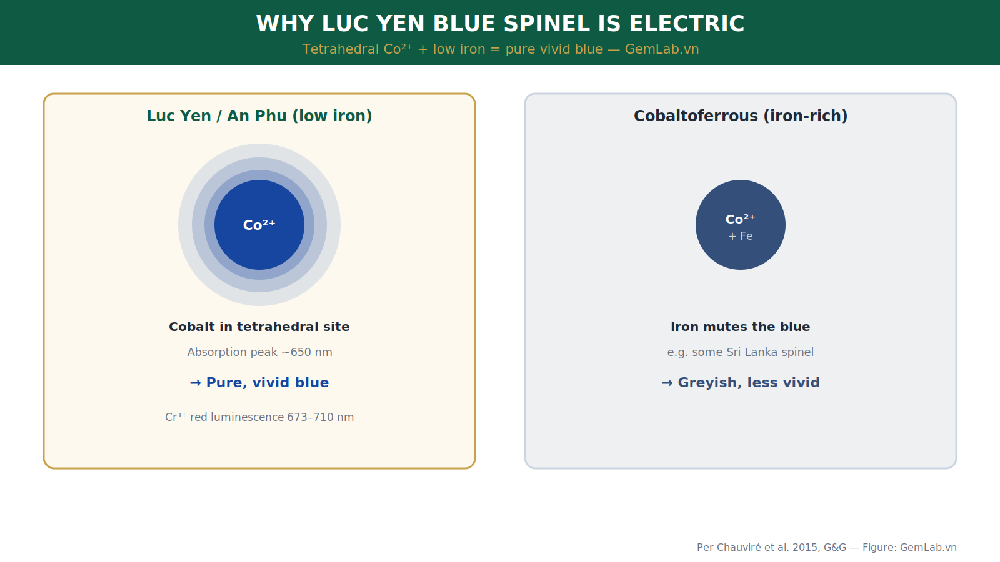
The secret of the "electric" blue lies in color chemistry — and this is the part that makes Luc Yen spinel special. According to GIA analysis, the blue color comes from the divalent cobalt ion (Co²⁺) in a tetrahedral site within the spinel structure, with a partial contribution from iron. The broad absorption peak around 650 nm is the signature of tetrahedral cobalt. The key point: iron content must be low for the blue to be pure and vivid; many cobalt spinels elsewhere (such as Sri Lanka) are iron-rich "cobaltoferrous" spinels and so rarely achieve the pure blue of Luc Yen.
An interesting optical phenomenon: because cobalt is sensitive to the light source spectrum, Luc Yen spinel can shift color slightly with lighting. Under a compact fluorescent lamp (rich in blue), the stone appears blue; under an incandescent lamp (rich in red), it shifts toward bluish purple. In addition, under laser excitation, the spinel shows strong red luminescence — due to chromium ions (Cr³⁺) substituting for aluminum in octahedral sites, producing characteristic peak groups in the 673–710 nm range. The coexistence of cobalt (for blue) and chromium (for red luminescence) in a single stone is a chemical signature of marble-hosted spinel.
This very sensitivity to light means that assessing the color of cobalt spinel requires discipline: a stone should be viewed under several standard light sources to describe its color truthfully, rather than photographed only under one flattering lamp. This is why a color description on a serious report is worth far more than an advertising photo — something buyers of high-end spinel should keep in mind.
It is worth underlining how unusual cobalt coloration is. Cobalt is a trace element that rarely concentrates enough in a gem crystal to dominate its color; in most blue gems the color comes from iron and titanium, not cobalt. When cobalt does take the lead, as in the finest Luc Yen and Sri Lankan stones, the result is a saturation that the eye reads as almost luminous. The Luc Yen advantage is that its marble-hosted setting kept iron low, letting the cobalt express its full intensity rather than being dulled — a combination of geology and chemistry that very few deposits on Earth reproduce.
Color range & differences between mining areas
Luc Yen spinel is not only blue. The area yields a rich color range: red, hot pink, pink-orange (evoking padparadscha), purple, and cobalt blue. Notably, different mining areas within the same district yield spinel with distinctly different trace-element "fingerprints":
| Mining area / feature | Chemical signature |
|---|---|
| Cong Troi (red, pink spinel) | Very low zinc (below ~500 ppm), high iron (3,000–16,000 ppm) |
| An Phu (including cobalt blue) | Zinc-rich (up to ~11,000 ppm) |
| Blue spinel | Cobalt (Co²⁺) creates the color; low iron gives pure blue |
| Red spinel | Chromium (Cr³⁺) creates color & red luminescence |
This trace-element difference (per Pham Van Long et al., 2018) is not just an academic detail — it allows a laboratory to distinguish spinel within the same Luc Yen district, and is the scientific basis for origin tracing. Note also the paragenesis: red spinel and ruby share a very similar mineral association, while blue spinel is linked to forsterite — reflecting different metamorphic histories within the same area.
This ability to discriminate by trace elements has a dual significance. Scientifically, it shows that Luc Yen spinel is not a uniform block but the product of several different geological micro-environments. For practical testing, it opens the prospect of origin tracing down to the mining-area level — though, like every origin conclusion, this requires trace-element instrumentation and must be expressed with an appropriate level of confidence, not overstated.
Identifying features & inclusions
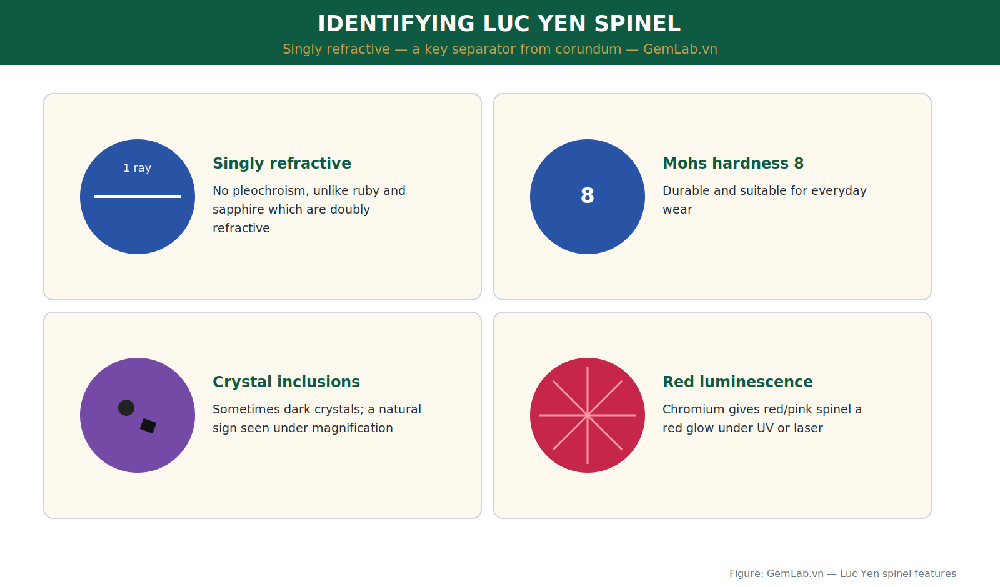
Spinel has gemological features that help distinguish it from other blue and red stones:
| Feature | Significance |
|---|---|
| Singly refractive | No pleochroism — unlike corundum (ruby/sapphire), which is doubly refractive |
| Mohs hardness 8 | Durable, suitable for frequent wear |
| Crystal inclusions (sometimes dark) | Some stones have dark crystals; a natural sign to examine closely |
| Red luminescence (red/pink spinel) | Chromium gives a red glow under UV/laser |
Spinel is singly refractive (optically isotropic) — an important feature that allows quick distinction from ruby and sapphire, which are doubly refractive and show pleochroism. This is one of the basic tests a polariscope and refractometer can perform. A major advantage of Luc Yen spinel: it is almost never treated — unlike most commercial ruby and sapphire, which are heated. However, the market is flooded with cheap synthetic spinel (especially in budget jewelry), so testing remains necessary to separate natural from synthetic.
Spinel vs ruby & "the great impostor"
Spinel carries a unique historical story: for centuries, some of the most famous "rubies" of royal houses were in fact red spinel — most famously the "Black Prince's Ruby" on the Imperial State Crown of England, which is actually a spinel. The reason for this historical confusion is easy to understand: red spinel and ruby are often found together in the same placers, have a similar red color, and are hard to tell apart by eye. Only with the rise of modern gemology was spinel finally "given back its name."
At Luc Yen, this co-occurrence is clear: ruby and red spinel share the same accompanying mineral association and often lie together in placer deposits. This has an important practical consequence — a red stone bought at Luc Yen could well be spinel rather than ruby (or vice versa), and the two have different market values. Distinguishing them is one of the core reasons for testing: spinel is singly refractive, ruby doubly refractive — a refractive index measurement and a polariscope observation are enough to tell them apart.
The beautiful irony is that this very historical confusion has today become a marketing advantage for spinel — the story of "the stone that fooled even royal houses" makes it appealing to collectors. And with Luc Yen spinel, the story gains an extra layer of pride: this is world-class spinel grown from Vietnamese soil itself.
Today spinel is no longer seen as an "impostor" but has become a gem prized for itself, with good hardness (Mohs 8), a vivid color range, and almost no treatment. Spinel has also been officially added to the modern August birthstone list — see the August birthstone guide.
Value & testing of Luc Yen spinel
Luc Yen cobalt-blue spinel ranks among Vietnam's most valuable colored stones, especially clean faceted stones over 1 carat, which are extremely rare. The factors determining value are the purity and vividness of the blue (depending on a high cobalt, low iron ratio), clarity, and size. GemLab does not quote specific prices because cobalt-blue spinel prices fluctuate strongly and depend on the individual stone, but one thing is clear: this is a segment where an independent testing report makes a major difference in trust and liquidity.
A market note that buyers of Luc Yen spinel should know: because cobalt-blue spinel is so rare and high-priced, the market contains synthetic blue spinel, dyed spinel, and iron-rich cobalt spinel from other sources "labeled" as Luc Yen. This is exactly where an independent report — confirming a natural stone, natural color, and where possible origin clues — shifts from "optional" to "essential." The higher the price, the greater the role of testing.
For spinel, testing answers these questions: whether the stone is natural spinel (distinguishing it from the very common synthetic spinel), whether the color is natural, and, where possible, origin clues from trace elements. As noted, a confident origin conclusion usually requires trace-element analysis (LA-ICP-MS) — GemLab identifies the gem species, assesses observable features, and states clearly when specialized analysis is needed. See GemLab's gemstone testing service.
Reference standards: Chauviré B. et al. (2015) "Blue Spinel from the Luc Yen District of Vietnam", Gems & Gemology Spring 2015 (color from Co²⁺, ~650 nm peak, Cr³⁺ luminescence 673–710 nm, Paleo-Tethys model); "Purple Gem Spinel from Vietnam and Afghanistan" G&G Fall 2021; Pham Van Long et al. (2018) trace elements of Luc Yen–An Phu spinel, Vietnam Journal of Earth Sciences (Zn/Fe Cong Troi vs An Phu). Market information is time-sensitive.
Frequently asked questions
What is Luc Yen cobalt-blue spinel? It is vivid blue spinel colored by cobalt ions (Co²⁺), mined mainly in the An Phu area of Luc Yen (Yen Bai). GIA recognizes Luc Yen as a leading world source of vivid blue spinel; it is one of Vietnam's most valuable colored stones.
What colors does Luc Yen spinel have besides blue? A rich range: red, hot pink, pink-orange evoking padparadscha, purple, and cobalt blue. Red spinel is colored by chromium and shows red luminescence; blue spinel by cobalt. Each color is linked to specific chemistry and a particular mining area.
Why is Luc Yen blue spinel more vivid than cobalt spinel elsewhere? Because the blue requires high cobalt and low iron. Many cobalt spinels elsewhere are iron-rich, so the color is muted; Luc Yen spinel is poorer in iron and so yields a rare, pure, vivid blue.
How does spinel differ from ruby? Spinel is a separate mineral, singly refractive (no pleochroism), while ruby is corundum, doubly refractive. Historically, many royal "rubies" were in fact spinel. A refractive index measurement and a polariscope observation tell the two apart.
Is Luc Yen spinel treated? Luc Yen spinel is almost never treated — a major advantage. However, beware the common cheap synthetic spinel in jewelry; testing helps separate natural from synthetic.
Can spinel be confirmed as coming from Luc Yen? A laboratory can offer an opinion based on trace elements (such as the Zn/Fe ratio that distinguishes mining areas) and inclusions, but a confident origin conclusion usually requires specialized LA-ICP-MS analysis.
Own a Luc Yen spinel? Have it tested to confirm its value. An independent laboratory specializing in Vietnamese colored stones separates natural from synthetic, assesses features, and is transparent about limitations. See GemLab's gemstone testing service.
Explore the Vietnamese gemstones cluster
This page is part of GemLab's Vietnamese gemstones cluster. Continue with the related in-depth pages: Vietnamese gemstones overview, Luc Yen ruby, and Vietnam sapphire. To have a stone examined, see GemLab's gemstone testing service. For the method behind telling stones apart, see natural vs synthetic vs fake gemstones.