
Every month of the year is associated with a particular gemstone that carries its own meaning, known as a birthstone. This page brings together the complete birthstone list for all twelve months according to the current international standard, along with their meanings, gemological characteristics, origins, and links to detailed analyses of each month, helping you look up and choose the right stone for your birth month.
What is a birthstone?
A birthstone is a gemstone associated with a person's month of birth, carrying symbolic meaning and traditionally believed to bring luck and protection to the wearer. The tradition has deep roots: in ancient Israel, the breastplate of the high priest Aaron was described as bearing twelve gemstones representing the twelve tribes. Over the centuries, each stone gradually became linked to a month of the year, forming the birthstone system used around the world today.
It is important to distinguish between cultural meaning and gemological reality. A birthstone is, first and foremost, a gemstone with a defined mineral composition, hardness, refractive index, and optical characteristics. So even when choosing a stone by birth month for good fortune, buyers should still rely on scientific testing to ensure the stone is genuine, correctly identified, and fairly valued, avoiding confusion with synthetic stones or undisclosed treated material.
The four international birthstone lists
The modern birthstone list was first standardized in 1912 by the American national association of jewelers, the forerunner of Jewelers of America. Since then, major organizations such as the American Gem Society and the Jewelry Council have added and adjusted entries to reflect the market, for example introducing Spinel for August in 2016 and Tanzanite for December in 2002. Alongside these, Eastern tradition links stones to the five elements and personal destiny, creating a parallel frame of reference.
GemLab presents birthstones according to the current international standard while also explaining the differences between lists, so you are not confused when a single month has more than one stone. This variation is normal and reflects the long history of each gem rather than a contradiction. When giving a gift, you can choose the stone that best suits the recipient's taste and budget among the options for that month.
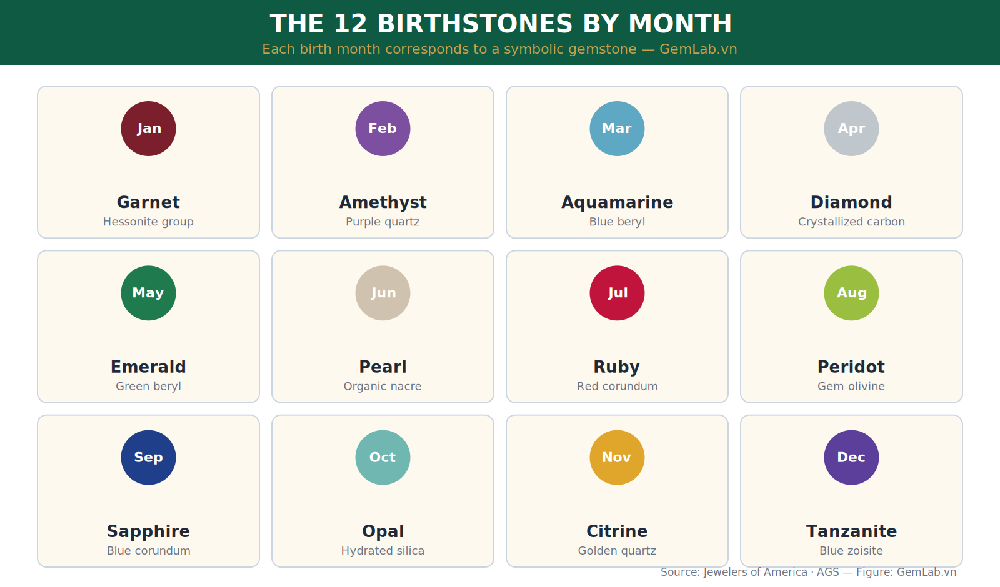
Birthstones month by month
January — Garnet
Garnet is the birthstone for January, a group of silicate minerals with a hardness of 6.5 to 7.5 on the Mohs scale and a color range spanning deep red, orange, yellow, and the rare green tsavorite. Its characteristic red symbolizes loyalty, friendship, and perseverance; in the past, Garnet was worn as a protective talisman for long journeys. When buying, take care to distinguish red Garnet from Ruby or red Spinel based on refractive index and inclusion characteristics. See the detailed January birthstone guide.
February — Amethyst
Amethyst is the birthstone for February, the purple variety of quartz colored by iron impurities and natural irradiation, with a hardness of 7 and no distinct cleavage, making it very durable for everyday jewelry. Its purple tones, from pale lilac to deep violet, are associated with clarity of mind and inner peace. The market contains a great deal of synthetic Amethyst and dyed quartz, so it is wise to verify origin before buying large stones with overly uniform color. See the detailed February birthstone guide.
March — Aquamarine
Aquamarine is the birthstone for March, a member of the beryl family like Emerald but with a clear sea-blue color caused by iron, a hardness of 7.5 to 8, and typically very high clarity. Its name comes from the Latin for sea water and is associated with calm and the courage of sailors. Aquamarine must be distinguished from blue topaz, blue quartz, and dyed glass, which can look similar but differ markedly in refractive index and specific gravity. See the detailed March birthstone guide.
April — Diamond
Diamond is the birthstone for April under the modern standard, an allotrope of crystallized carbon with a perfect hardness of 10 on the Mohs scale and high dispersion that creates its signature fire. A symbol of eternity and lasting love, a diamond's value is assessed through the 4Cs of carat weight, color, clarity, and cut. Because synthetic diamonds and simulants such as moissanite exist, independent testing is essential. See the detailed April birthstone guide.
May — Emerald
Emerald is the birthstone for May, the green variety of beryl colored by chromium and vanadium, with a hardness of 7.5 to 8 but often brittle due to the many internal inclusions that gemologists affectionately call the jardin, or garden. Deep, even, and vivid green largely determines its value. Most Emeralds on the market are oil-treated to improve clarity, an accepted treatment that must nonetheless be clearly disclosed on the testing report. See the detailed May birthstone guide.
June — Pearl, Moonstone, and Alexandrite
June has as many as three birthstones. Pearl is an organic gem formed within a mollusk, shimmering with nacre and symbolizing purity. Moonstone belongs to the feldspar group and produces an ethereal adularescence, or moonlight effect. Alexandrite is a rare variety of chrysoberyl, famous for changing color from green in daylight to purplish red under incandescent light. This diversity gives those born in June many choices to match their style and budget. See the detailed June birthstone guide.
July — Ruby
Ruby is the birthstone for July, the red variety of the mineral corundum colored by chromium, with a hardness of 9 second only to diamond and very high durability. Its pigeon-blood red is among the most sought-after colors in the colored-stone world. Vietnam is a renowned ruby source, with the Luc Yen and Quy Chau regions. Ruby is commonly heat-treated to improve color and clarity; the degree of treatment greatly affects value and should be clearly stated on the testing report. See the detailed July birthstone guide.
August — Peridot and Spinel
August has Peridot and Spinel. Peridot is the gem variety of olivine, with a characteristic yellow-green color from iron, a hardness of 6.5 to 7, and often strong birefringence that creates a doubling of the back facets. Spinel was officially added in 2016; long mistaken for Ruby in many royal artifacts, it is now highly valued for its natural, untreated red, pink, and blue hues. Vietnam is also a source of high-quality Spinel at Luc Yen. See the detailed August birthstone guide.
September — Sapphire
Sapphire is the birthstone for September, also a member of the corundum family like Ruby with a hardness of 9, but only corundum of any color other than red is called Sapphire. Royal blue is the most famous, though Sapphire also occurs in pink, yellow, green, and even colorless. Its high durability makes Sapphire very popular for engagement rings. Like Ruby, Sapphire is commonly heat-treated, and the degree of treatment should be disclosed for accurate valuation. See the detailed September birthstone guide.
October — Opal and Tourmaline
October has Opal and Tourmaline. Opal is a hydrated silica mineral that produces a unique rainbow play of color, with a hardness of only 5.5 to 6.5 and a need to be protected from drying and cracking. Tourmaline is a group of borosilicate minerals spanning the entire spectrum, notable for stones with two or three colors in a single crystal and the pink-and-green watermelon variety. Both give those born in October a rich choice of color. See the detailed October birthstone guide.
November — Topaz and Citrine
November has Topaz and Citrine, both warm-toned and symbolizing prosperity. Topaz is an aluminum fluorosilicate hydroxide mineral with a hardness of 8, most beautiful and prized in the golden-orange Imperial color; much of the blue topaz on the market is colorless topaz that has been irradiated. Citrine is the yellow-to-orange variety of quartz with a hardness of 7; most commercial Citrine is heat-treated Amethyst, which must be distinguished from the rarer natural Citrine. See the detailed November birthstone guide.
December — Tanzanite, Turquoise, and Zircon
December has three cool-toned birthstones. Tanzanite is the blue-violet variety of zoisite, found only at the foot of Mount Kilimanjaro in Tanzania, and is almost always gently heat-treated to reveal its blue-violet color. Turquoise is an ancient blue-green copper aluminum phosphate mineral, soft and porous and therefore often stabilized. Natural Zircon displays brilliant fire and strong birefringence, and must be clearly distinguished from synthetic cubic zirconia, which is an entirely different material. See the detailed December birthstone guide.
Quick birthstone reference table
| Month | Birthstone |
|---|---|
| January | Garnet |
| February | Amethyst |
| March | Aquamarine |
| April | Diamond |
| May | Emerald |
| June | Pearl, Moonstone, and Alexandrite |
| July | Ruby |
| August | Peridot and Spinel |
| September | Sapphire |
| October | Opal and Tourmaline |
| November | Topaz and Citrine |
| December | Tanzanite, Turquoise, and Zircon |
Gemological properties and durability of birthstones
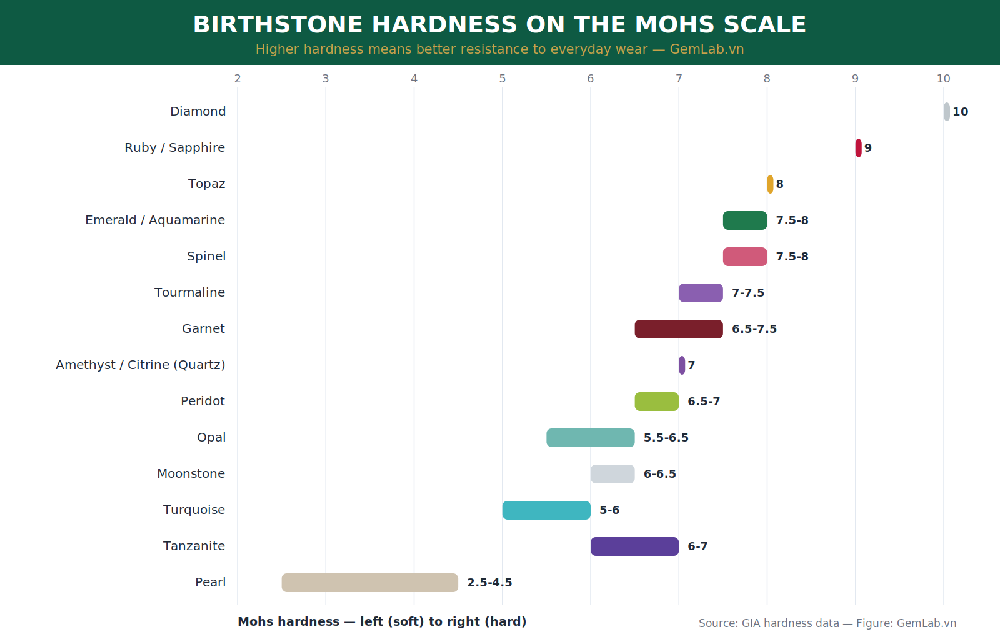
Birthstones vary greatly in durability, which is worth considering when choosing jewelry for frequent wear. Diamond, Ruby, and Sapphire have a hardness of 9 to 10 and resist wear well, making them suitable for everyday rings. The quartz family, such as Amethyst and Citrine, at a hardness of 7 remains fairly durable. By contrast, Opal, Pearl, Turquoise, and Tanzanite are softer or more fragile and are better suited to pendants, earrings, or jewelry less exposed to impact. Understanding these properties helps a birthstone gift stay beautiful over time.
Eastern birthstones and the five elements
Alongside birthstones by calendar month, Eastern culture also selects stones by the five elements of personal destiny and by zodiac sign. These approaches complement one another: the birth month indicates a symbolic stone, while destiny and zodiac suggest colors and stone types that harmonize energetically. You may consult zodiac stones and feng shui stones by destiny element for a complete choice that balances symbolic meaning with personal feng shui.
Giving birthstones for special occasions
A birthstone is a meaningful personalized gift for a birthday, but many of these stones are also tied to wedding anniversary milestones, making them a dual-purpose gift choice. By Western custom, Pearl marks 30 years of marriage, Ruby symbolizes 40 years, Sapphire 45 years, and Diamond 60 years. When giving, choose a type of jewelry suited to the stone's durability: rings for hard stones such as Ruby, Sapphire, and Diamond, and pendants or earrings for softer stones such as Opal, Pearl, or Tanzanite. Whether given by birth month or anniversary milestone, a stone with a testing report always makes a gift more distinguished, preserves its value, and reflects the giver's thoughtfulness.
How to choose a birthstone
When choosing a birthstone, consider three factors: the birth month that defines the symbolic stone, personal preference in color and style, and most importantly the authenticity of the stone. Many popular birthstones such as Ruby, Sapphire, Emerald, and Diamond have synthetic or treated versions, so an independent testing report is the only way to ensure you own the genuine stone at a value to match. Consider a professional gemstone testing service to verify high-value stones before purchase.
Frequently asked questions
What is a birthstone? A birthstone is a gemstone associated with a person's month of birth, carrying symbolic meaning and traditionally believed to bring luck and protection to the wearer, while also being a gemstone with defined gemological characteristics.
Why does each month have its own stone? The tradition originates from the twelve stones on the breastplate of the high priest Aaron in ancient Israel, which gradually became linked to the twelve months and were standardized into the modern list from 1912.
Are birthstones counted by the solar or lunar calendar? The international birthstone system follows the solar calendar. Choosing stones by zodiac sign or the five elements is a different frame of reference that can be used as a complement rather than a replacement.
Can a month have more than one birthstone? Yes. Many months such as June, August, October, November, and December have more than one stone because different international lists added entries over time, giving the wearer more choice in color and budget.
How do birthstones differ from zodiac stones? Birthstones follow the solar calendar, with one symbolic stone per month. Zodiac stones follow the constellations, with each sign spanning two calendar months, so the two systems do not align.
How can I tell if a birthstone is genuine? The surest way is testing at an independent laboratory. A testing report confirms the stone type, whether it is natural or synthetic, and any treatments, giving you peace of mind about the stone's true value.
Once you have chosen the birthstone you love, the next step is to ensure it is genuine and fairly valued through professional testing.